DRV11-J parallel line interface user's guide
Order Number: EK-DRV1J-UG
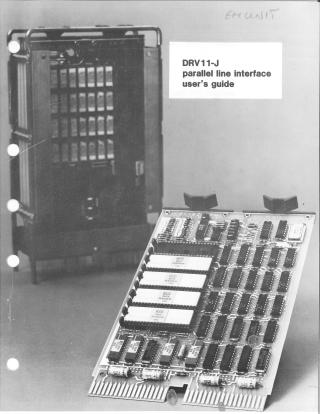
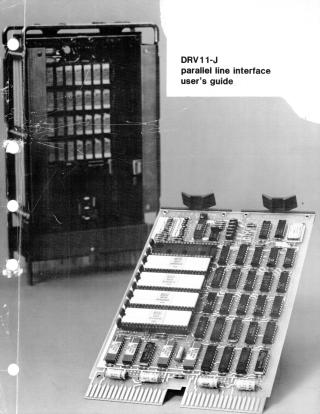
This document is a user's guide for the DRV11-J, a double-height parallel line interface module designed for LSI-11 microcomputer systems. It provides detailed information on the module's general description, features, specifications, and functional operation.
The DRV11-J features four programmable 16-bit parallel I/O ports (A, B, C, D) for data transfer between the LSI-11 bus and external user devices. It supports up to 16 external interrupt requests, generating individual vector addresses, making it suitable for real-time I/O and sensor applications. The module's operation is highly configurable through programmable mode registers, allowing selection between vectored-interrupt-driven or software-polled systems, fixed or rotating interrupt priority, common or individual vector addresses, and active high/low interrupt request polarity, as well as a master mask for interrupts.
The document details the various control/status registers (CSRA, CSRB, CSRC, CSRD) and data buffer registers (DBRA, DBRB, DBRC, DBRD) used for programming and data transfer. It also explains the interrupt control logic, including Interrupt Request Registers (IRR), Interrupt Service Registers (ISR), Interrupt Mask Registers (IMR), and Auto-Clear Registers (ACR), along with how interrupt vector addresses are stored in onboard RAM.
Further sections cover physical and electrical specifications, environmental requirements, installation procedures, and diagnostic software. It also describes interfacing connections, signal functions, assertion levels, and timing, offering programming examples for data transfer with and without handshaking, and interrupt-driven transfers. An example of an optic isolator interface for hostile electrical environments is also included.
Site structure and layout ©2025 Majenko Technologies