DLV11-E and DLV11-F Asynchronous Line Interface User's Manual
Order Number: EK-DLV11-OP
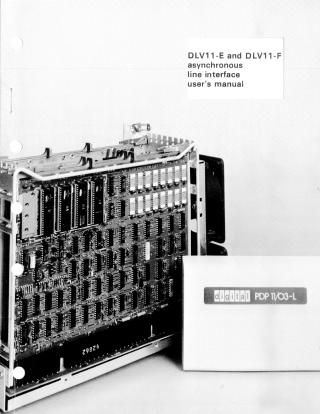
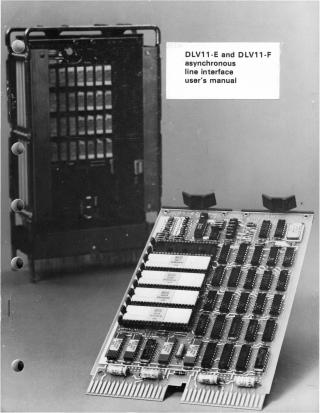
This document is the User's Manual for the Digital Equipment Corporation (DEC) DLV11-E and DLV11-F asynchronous line interface modules, published in June 1977.
These modules serve as interfaces between the LSI-11 bus and various serial communication lines, converting serial data to parallel for computer input and parallel data to serial for peripheral output.
Key differences between the two models:
- The DLV11-E offers full modem control and is designed for EIA Standard RS232C and CCITT Recommendation V.24 data sets (e.g., Bell 103, 202C/D).
- The DLV11-F supports either 20 mA current loop or EIA-standard "data leads only" operation, specifically without modem control.
Common features of both modules include:
- Jumper- or program-selectable crystal-controlled baud rates (50 to 9600 baud).
- Provisions for user-supplied external clock inputs.
- Jumper-selectable parity and data bit formats.
- LSI-11 bus interface logic for interrupt processing and vectored addressing.
- Directly accessible control, status, and data buffer registers.
- Compatibility with PDP-11 DL11 series asynchronous line interface modules.
The manual provides comprehensive information on:
- Introduction, purpose, operating features, and specifications.
- General and detailed descriptions of module functions and circuit components, including the bus interface, I/O control logic, data buffers, interrupt logic, baud rate control, break logic, maintenance mode, and peripheral interfaces.
- Installation procedures, covering jumper configuration, physical module installation, and diagnostic checkout.
- Programming details, such as device registers, interrupt handling, and timing considerations, with programming examples.
- Appendices that describe the integrated circuits used within the modules and provide wire-wrap jumper instructions for modification.
Site structure and layout ©2025 Majenko Technologies