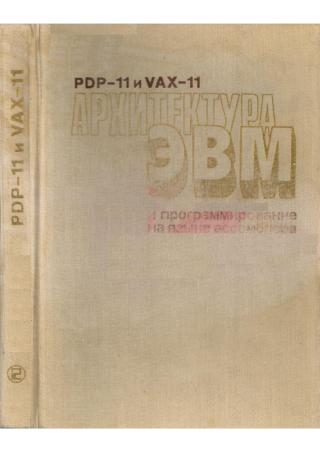
PDP-11 и VAX-11. Архитектура ЭВМ и программирование на языке ассемблера
Order Number: 5-256-00299-6
This document is a Russian translation of Wen C. Lin's textbook, "Computer Organization and Assembly Language Programming for the PDP-11 and VAX-11." Published in 1989, it aims to provide a comprehensive guide to the architecture and assembly language programming of these influential Digital Equipment Corporation (DEC) computer systems. The preface emphasizes the continued relevance of assembly language for system programming and microprocessor development, especially given the scarcity of such technical literature in Russian at the time.
The book is structured into 11 chapters, covering fundamental and advanced topics:
- Introduction to Computer Fundamentals: Basic principles of computer operation, Von Neumann architecture, computer system components, and human-computer interaction.
- PDP-11 System Organization: A detailed look at the central processor (CPU), including registers, the Arithmetic Logic Unit (ALU), control unit, and memory organization from a user's perspective.
- Information Representation: Explores various number systems (binary, octal, hexadecimal), signed number representation using two's complement, and floating-point number formats.
- PDP-11 Instruction Set: Covers data transfer, arithmetic, logical operations, various addressing modes, and the concept of position-independent code.
- Subroutines: Discusses the use of subroutines, parameter passing mechanisms, nested subroutines, recursion, and simple sorting algorithms.
- Macros and Macroinstructions: Explains the definition, classification, and application of both system-defined and user-defined macros, including nested macro structures.
- Input/Output Programming: Delves into the programming aspects of I/O operations, asynchronous I/O, and the use of buffers.
- Interrupts and Traps: Explains the principles, hardware structures, and programming of external interrupts and internal program traps (exceptions).
- Direct Memory Access (DMA): Introduces the concept of DMA for high-speed data transfer between peripherals and memory without continuous CPU intervention.
- Introduction to VAX-11: Provides an overview of the VAX-11 architecture, comparing it with the PDP-11, and covers its extended instruction set, memory management (including virtual memory), and multiprocessing features.
- Laboratory Exercises: Offers practical programming tasks of increasing complexity to reinforce theoretical knowledge.
The book also includes appendices with ASCII character codes and comprehensive listings of PDP-11 and VAX-11 instruction sets, serving as a practical reference for programmers and engineers.
Site structure and layout ©2025 Majenko Technologies