scnsrf
Order Number: XX-4CEC6-3C
This document describes the SCNSRF (Scanner and Console Teletype Service Routine), a comprehensive low-level software component designed for managing input/output (I/O) operations for teletype (TTY) and scanner devices within a Digital Equipment Corporation (DEC) system, dating back to 1969.
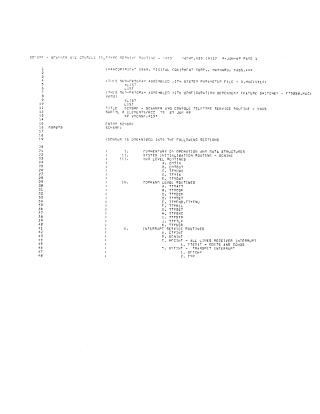
The routine is structured into the following key areas:
- System Initialization (
SCNINI): Sets up the operating environment, clears I/O flags, and initializes Device Data Blocks (DDBs) for all TTYs and scanners. - Device Management: Includes routines for attaching and detaching TTYs to specific jobs, placing TTYs into user or monitor modes, and releasing or "killing" TTY devices, along with handling "talk ring" configurations.
- Buffer Management: Implements ring buffers for both input and output. This involves a sophisticated system of pointers and counters (e.g.,
PUTR,TAKR,PCTR,FCTR) to manage character storage, retrieval, and track available buffer space efficiently. - Character I/O Processing:
- Input (
DOTIN,GETCHR,TTEDIT): Routines to get characters from input buffers, handle various special characters (e.g., control codes like Control-C, rubout, line breaks) and their corresponding actions, perform keyboard editing (like backspace and line deletion), and manage echoes to the console. - Output (
DDTOUT,PUTCHO,OUTCHR): Routines to place characters into output buffers, handle device-specific output actions (e.g., carriage return, line feed, tab, form feed), and manage special character outputs that might trigger specific device behaviors.
- Input (
- Interrupt Handling (
CTYINT,RECINT,XMTINT): Dedicated interrupt service routines manage asynchronous I/O events for console TTYs, general keyboard receivers, and data transmitters. These routines are critical for real-time processing of input, echoes, and managing the state of the system during I/O. - Configuration & Data Structures:
- The system heavily relies on a Device Data Block (DDB) for each TTY (whether a physical device or a "pseudo-TTY"), which stores crucial information like device status, buffer parameters, line characteristics (e.g., half-duplex, remote, console type), and job-related data.
- A Special Character Table (
SPCTAB) defines system-wide actions for a wide range of ASCII control characters, dictating how the routine responds to various inputs. - Translator Tables map logical TTY properties to their physical characteristics and associated job numbers.
The SCNSRF provides a UUO (User Unimplemented Operation) interface, allowing higher-level system components to invoke complex I/O functions through a dispatch table. The document details the low-level implementation, including memory addresses and specific instruction sequences, making it a technical specification likely intended for system programmers and device driver developers.
Site structure and layout ©2025 Majenko Technologies