ptysrh
Order Number: XX-4ED17-69
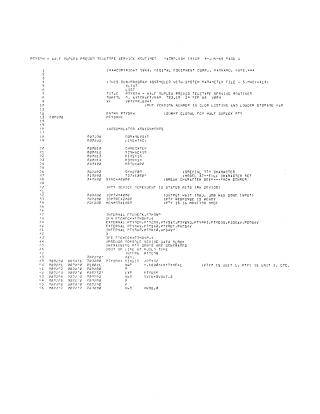
This document is a MACRO assembly language listing for "PTYSRH: Half Duplex Pseudo Teletype Service Routines," developed by D. Witcraft/RAP for Digital Equipment Corporation, dated June 4, 1969.
The code defines and implements the core software functions for managing a pseudo (simulated) teletype device operating in half-duplex mode. It serves as a low-level driver or operating system component, handling input and output for virtual terminals.
Key functionalities and components include:
- Initialization: Setup of accumulator assignments, definition of device-dependent I/O status bits (e.g.,
IOPTWfor output wait,IOPTREfor response ready,MONMODfor monitor mode). - Output Routine (
PTYOUT): Manages character transmission, output buffers, handling responses from the pseudo teletype, and setting relevant status flags for the "object job" (application) interacting with the device. - Input Routine (
PTYIN): Handles the processing of incoming characters and managing input buffers. - Synchronization (
PTWAKE,PTYPE): Includes routines to intercept TTY output at the UUO (User-User-Output) level to synchronize it with pseudo teletype input, likely involving a system clock. - Status Management (
PTYSET,PTYMNMD,PTYOW): Routines for setting various internal status bits related to the pseudo teletype's operational state, such as monitor mode or output wait. - Context Saving/Restoration (
PTYSAV,PTYRET): Functions to preserve and restore the state of accumulators (registers) and I/O registers during operations, crucial for multi-tasking or interrupt handling. - Data Structures: Defines the "Pseudo Console Device Data Block" (
PTYDDB), which stores information about each pseudo teletype unit.
The document provides detailed assembly code, comments explaining logic, accumulator assignments, status bit definitions, and a symbol table. It describes how the routines interact with system components like TCOMM (teletype communication) and TTYTAB (teletype table) to provide a robust pseudo teletype service.
Site structure and layout ©2025 Majenko Technologies