pltser
Order Number: XX-ED4CE-ED
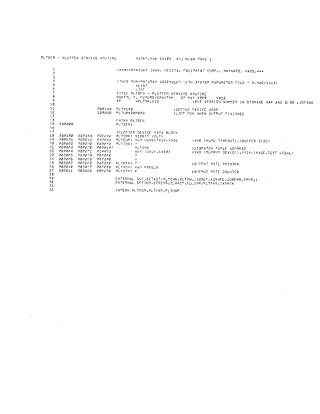
PLTSER (PLOTTER SERVICE ROUTINE) is an assembly language sub-program for Digital Equipment Corporation (DEC) systems, developed in 1969. Its primary purpose is to manage and control a plotter device.
The routine provides core functionalities for interacting with the plotter, including:
- Device Definition and Data Management: It defines a device code (PLT=140) and uses a "PLOTTER DEVICE DATA BLOCK" (PLTDDB) to store critical information such as buffer size, timeout settings, output byte pointers (PLTPTR), and byte counters (PLTCTR).
- Dispatch Table: An internal dispatch table routes requests to various subroutines for different operations like initialization, error handling, releasing resources, closing the device, and performing output/input.
- Output Operations: The
PLTOUTsection handles the initiation of output to the plotter. This includes setting up byte pointers and counters, activating the device, assigning priority channels, putting the plotter into the device chain, and starting the plotter with the pen in an initial state (pen up). - Interrupt Service Routine (
PLTINT): This critical section manages the plotter during active output. It checks the plotter's status, determines if more characters need to be sent from the buffer, retrieves the next character, sends it to the plotter, and dismisses the interrupt. It also handles buffer advancement and checks for "no more data." - Buffer and Data Formatting (
PLTSET): This subroutine calculates byte pointers and counters for the output buffer. It's responsible for determining if the data is text (converting between 6-bit or 7-bit byte pointers) or image/binary (handling 6 bytes per word) and adjusts the word count to a byte count accordingly. It also performs address checks for the output buffer. - Device Shutdown (
PLTOFF): This routine handles the completion of plotter operations, including removing the plotter from the device chain and lifting the pen if the "close" operation has been performed. - Error Handling: The routine incorporates mechanisms for detecting and responding to errors, such as a "HUNG DEVICE ERROR" or "ADDRESS ERR RETURN."
Overall, PLTSER acts as a low-level device driver, mediating between the operating system or application and the physical plotter, managing data transfer, device state, and interrupt-driven I/O.
Site structure and layout ©2025 Majenko Technologies