DEC-10-J00B-D PDP-10 Reference Card
Order Number: XX-C52E8-0E
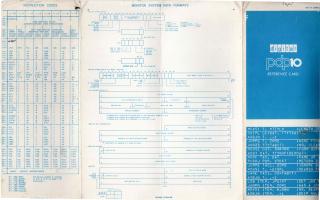
This document appears to be a reference manual for a computer system, likely a Digital Equipment Corporation (PDP-10, given the logo on page 1). It provides a comprehensive overview of the instruction set and various data and word formats used by the system and its associated Monitor System.
Key information includes:
Instruction List/Codes: A detailed list of operations the processor can perform, encompassing:
- Data Movement: MOV, BLock Transfer, EXCHange, PUSH/POP.
- Arithmetic: ADD, SUBtract, MULtiply, DIVide (integer and floating-point), SCale, Negate.
- Logical Operations: AND, OR, XOR.
- Bit Manipulation: Arithmetic/Logical SHift, ROTate, TEST.
- Control Flow: JUMP (conditional and unconditional), SKIP, COMPARE, HALT, eXeCuTe.
- System Operations: SET, DATA BLOCK, CONDITIONS, and specific jumps related to flags and system calls.
Monitor System Data Formats: Specific structures used for system-level operations, particularly for I/O and file management:
- DEVICE STATUS WORD
- I/O PARAMETER BLOCK
- FILE EXTENSION (FEW)
- OPEN OR INIT PARAMETERS
- BUFFER HEADER
- INPUT/OUTPUT (general)
Basic Word Formats: Delineates how information is structured in memory:
- Instruction Code: Fields for opcode, device code, and operands (A, F, I, X, Y).
- PC Word (Program Counter): Includes various flags (Overflow, Carry, Interrupt, User, Floating-point Underflow/No Divide).
- Pointers: BLT (Block Transfer), BLKI/BLKO, Pushdown, and Byte Pointers (specifying position and size).
- Data Types: Fixed-point operands (binary number, two's complement) and Floating-point operands (excess 128 exponent, fraction in two's complement), including a low-order word format for double-length floating-point numbers.
- Byte Storage: Illustrates how bytes are arranged within a word.
In essence, the document serves as a guide for programmers, detailing the machine's capabilities through its instruction set and specifying the memory layouts for both program code and various types of data.
Site structure and layout ©2025 Majenko Technologies