EOP Class Instructions
Order Number: PX-TCMEM-32
| Volume | 32 |
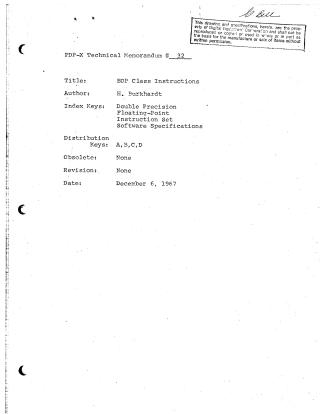
This PDP-X Technical Memorandum #32, dated December 6, 1967, defines a new class of Extended Operation (EOP) instructions for the PDP-X computer architecture. Specifically, it details operations for double-precision integers and floating-point numbers (both single and double precision).
These EOPs are currently implemented through resident software. However, they are designed to allow for future hardware implementation without requiring changes to existing software, making them an efficient way to integrate complex operations via the standard assembler and concise calling sequences.
The document categorizes these new EOPs into two main groups:
Double-Precision Operations: These instructions operate on signed, 2's complement double-precision integers. Operands are typically between an accumulator and a memory location, requiring even memory addresses for proper alignment. The defined instructions include: Load, Store, Add, Subtract, Test, Complement, Increment, Negate, Right Rotate, Left Rotate, Clear, Compare, Multiply, and Divide. Arithmetic errors in these operations can set a Program Status Word (PSW) bit and trigger traps.
Floating-Point Operations: These EOPs handle both single-precision (32-bit) and double-precision (64-bit) floating-point quantities, utilizing four dedicated 64-bit floating-point accumulators. The high-order AC-bit of an instruction differentiates between single and double-precision modes. Memory addresses for single-precision operands must be even, while double-precision operands require addresses divisible by four. Key aspects covered include normalization, handling of true zero, and exponent manipulation. Instructions in this category include: Load (and Load Negative), Store, Normalized Add (and Unnormalized Add), Normalized Subtract, Multiply, Divide, Compare, Test, Negate, Absolute Value, and Clear. These operations also specify conditions for exponent overflow/underflow, divide-by-zero, and error traps.
The memorandum provides detailed definitions for each instruction, including mnemonics, operational codes, and how condition codes are affected.
Site structure and layout ©2025 Majenko Technologies