PDP-X System Architecture
Order Number: XX-E0DE6-49
| Volume | 6 |
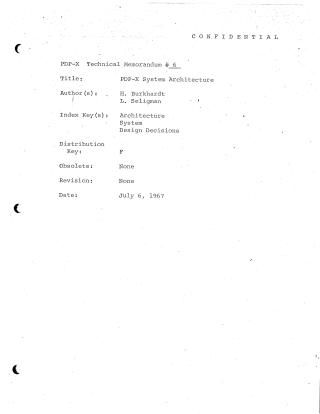
This document outlines the PDP-X System Architecture, a confidential technical memorandum from July 6, 1967. The architecture emphasizes logical structure and longevity over physical implementation, designed to be adaptable across a wide range of costs and complexities, from small I/O controllers to multi-user systems. It is presented as a refinement of the PDP-8, incorporating design advances for future competitiveness.
Key characteristics of the PDP-X architecture include:
- Efficient Memory Utilization: Achieved through a powerful instruction set and an addressing structure that minimizes memory waste, supporting both compact 16-bit and comprehensive 32-bit instructions.
- Wide Range of Processor Performance: The design allows for various processor models with scalable performance, leveraging a flexible OP code set, variable interrupt levels, and the use of core memory to replace hardware registers, as well as Read-Only Storage (ROS) for dedicated controllers.
- Software and Hardware Integration: Prioritizes ease of use with modular, error-detecting software, clean calling sequences, common I/O interfaces, and independent placement of instructions and data, all supported by robust documentation.
- Real-time and Multiuser Environment: Supports dedicated, OEM-embedded, and multi-user real-time applications by minimizing problem switching overhead. This is done through multiple general register sets and a dual memory map, which also facilitates shared code and simplifies system programming.
- Processor Module Concept: Introduces the idea of replacing complex, specialized I/O controllers with small, general-purpose processors dedicated to I/O control, utilizing software and ROS. This approach lays the groundwork for future multiprocessing capabilities.
- Modular Implementations: Focuses on manufacturing efficiency by partitioning the system into independent, small subassemblies suitable for automated testing and designed for replacement by maintenance personnel rather than repair.
Overall, the PDP-X architecture aims to provide a robust, flexible, and cost-effective foundation for future Digital Equipment Corporation (DEC) computer systems, addressing issues like memory efficiency, scalability, and ease of use in a competitive market.
Site structure and layout ©2025 Majenko Technologies