VAX 8600 Processor
Order Number: 0-932376-83-5
| Volume | 1 |
| Issue | 1 |
This Digital Technical Journal issue is dedicated to detailing the design, engineering, and technological foundations of Digital Equipment Corporation's VAX 8600 Processor. The VAX 8600 was designed to achieve a significant performance leap (up to 4 times faster than the VAX-11/780) while maintaining full compatibility with the VAX architecture and ensuring high reliability.
Key aspects and innovations covered include:
- Pipelined Architecture: The processor employs a sophisticated multi-stage pipeline, distributing processing across independent "boxes" – the I Box (instruction prefetch, decode, operand fetch), E Box (instruction execution and system control), and F Box (fast floating-point operations). This parallel processing enables an 80-nanosecond machine cycle time and a peak execution rate of 12.5 MIPS.
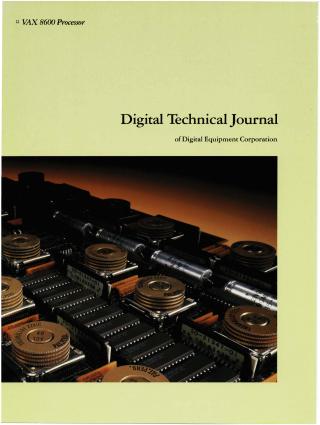
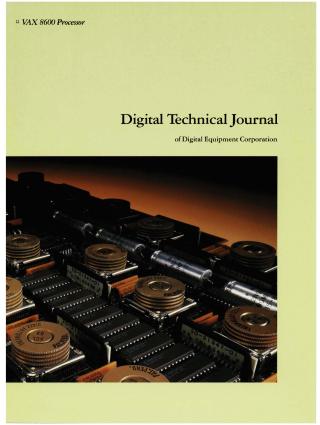
- Advanced Component Technology: The system extensively uses high-speed Emitter-Coupled Logic (ECL) macrocell arrays (MCAs), which offer fast gate speeds and high density, controlled by sophisticated microcode.
- Memory System Enhancements: A large, two-way associative 16KB "writeback" data cache and a dedicated memory bus are used to minimize memory access times and improve overall throughput by reducing contentions.
- Robust Physical Design: Significant attention was paid to packaging, cooling, and signal integrity. This involved developing new techniques for mounting MCAs with heat sinks, creating an advanced air-cooling system designed for quiet operation and efficient heat removal (addressing MCAs' 5-watt dissipation), and implementing stringent controls over signal paths to manage noise, reflections, and crosstalk.
- High Reliability and Maintainability: The VAX 8600 incorporates extensive features for fault avoidance (e.g., robust component quality, improved manufacturing), fault tolerance (e.g., instruction retry, ECC for memory and cache, duplicated General Purpose Registers for consistency), and fault minimization. Detailed diagnostics and an Environmental Monitoring Module (EMM) for temperature and voltage monitoring enhance the Mean Time To Repair (MTTR).
The document also emphasizes the extensive engineering efforts, including the development of new software tools for simulation and analysis, and a highly collaborative design process essential for managing the complexity of such a high-performance system.
Related Documents
| VAX Hardware Handbook (1982-83) | EB-21710-20 |
Site structure and layout ©2025 Majenko Technologies