The Omnibus Interface
Order Number: H919
This document serves as a comprehensive guide to the "OMNIBUS" interface system for the PDP-8/E computer. It provides essential information for designers and engineers who need to build special interface modules.
Key areas covered include:
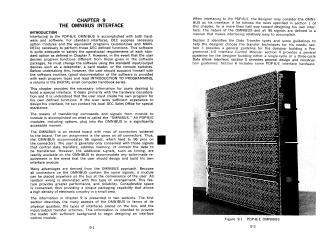
- OMNIBUS Overview: A description of the OMNIBUS as an etched circuit board acting as the central communication bus for all PDP-8/E modules, eliminating random backplane wiring and allowing high-density, flexible hardware configurations.
- System Configuration & Logic: Detailed specifications on logic levels and the system layout, including how to expand the system with off-the-shelf control units and external bus options.
Data Transfer Methods: An in-depth analysis of three primary methods:
- Programmed I/O Transfers: The simplest method, relying on the processor to service flags via subroutines.
- Interrupt Facility: A more efficient method using the interrupt system for time-sensitive data transfers.
- Data Break Transfers: The most efficient method for high-speed, direct memory access (DMA).
Interface Design & Construction: Practical guidelines for designing interface modules, including device selection circuits, operations decoders, signal loading rules, and physical board layout techniques to ensure performance and reliability.
- External Bus Expansion: Information on connecting peripherals using external bus interfaces (Positive I/O Bus and Data Break) for systems requiring greater versatility or compatibility with older PDP-8 peripherals.
- Timing & Troubleshooting: Extensive timing diagrams, flow charts, and design checklists to assist in verifying interface logic, timing, and grounding, as well as final testing procedures to ensure system integrity.
- Hardware Accessories: A catalog of available DEC modules (such as bus drivers, receivers, and connectors) that can be used to construct custom interfaces.
Site structure and layout ©2025 Majenko Technologies