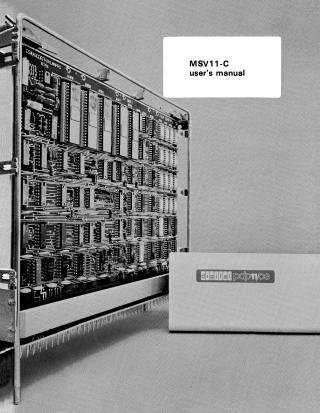
MSV11-C User's Manual
Order Number: EK-MSV11-OP
This document is a user's manual for the MSV11-C series of dynamic Metal Oxide Semiconductor (MOS) read/write memory options from Digital Equipment Corporation.
Key aspects summarized:
- Product Scope: It covers four models: MSV11-CA (4K), MSV11-CB (8K), MSV11-CC (12K), and MSV11-CD (16K), all by 16-bit, designed for LSI-11 bus-compatible systems like the PDP-11/03.
- Core Features:
- Memory Type: Volatile dynamic MOS memory.
- Self-Sufficiency: It includes an on-board refresh circuit, eliminating the need for external refresh signals from the LSI-11 bus (though it can be configured to respond to them). It also features an on-board charge pump circuit to generate its necessary -5V operating voltage from the standard +5V and +12V system power, and supports battery backup.
- Configurability: Users can select the starting memory address (at any 4K bank boundary) via switches and configure refresh modes, battery backup, and bus grant signals using jumpers.
- Bus Protocol: It performs standard LSI-11 bus cycles (DATI, DATO, DATOB, DATIO, DATIOB).
- Technical Description: Details the internal components such as the memory array (comprising 64 4Kx1-bit integrated circuits across four banks), addressing logic, and timing/control logic that manage read, write, and refresh operations.
- Installation & Maintenance: Provides instructions for proper module installation and removal (requiring DC power removal). It also outlines diagnostic procedures and, importantly, details how to reconfigure the module's jumpers (W4, W8, W12, W16) to disable faulty 4K memory banks, allowing a partially failed module to remain in use with reduced capacity.
Site structure and layout ©2025 Majenko Technologies