KDF11-AA User's Guide
Order Number: EK-KDF11-UG
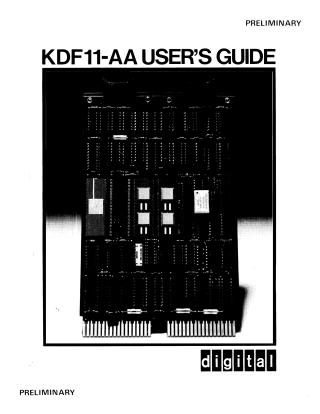
This "KDF11-AA USER'S GUIDE" is a comprehensive technical manual describing the KDF11-AA processor, a 16-bit, high-performance microprocessor developed by Digital Equipment Corporation. It forms the core of the LSI-11/23 processor and is designed to be software-compatible with the PDP-11 family.
The document covers the following key areas:
Introduction and Specifications:
- The KDF11-AA (M8186) utilizes MOS/LSI technology, offering full PDP-11/34 functionality.
- It features a standard Memory Management Unit (MMU) for 128K words of protected, multiuser program space (extending beyond older LSI-11's 32K limit) and supports an optional Floating Point (KEF11-A) for accelerated floating-point operations.
- Key features include a 4-level vectored interrupt system, parity checking on the LSI-11 bus, over 400 instructions, 16-bit word or 8-bit byte addressable locations, 8 internal general-purpose registers (R6 as Stack Pointer, R7 as Program Counter), stack processing, asynchronous bus operation, Direct Memory Access (DMA), and power fail/restart protection.
Installation:
- Details jumper configurations for user-selectable features (e.g., master clock, power-up mode, halt/trap options).
- Provides information on compatible LSI-11 bus backplanes (H9270, H9273-A, H9281, DDV11-B) and module contact identification.
- Highlights minor system differences compared to older LSI-11 (KD11-F) and LSI-11/2 (KD11-HA) processors, such as the absence of a microcode boot loader, different Console ODT functions, and lack of on-board memory refresh by the KDF11-AA.
Console ODT (Octal Debugging Technique):
- Explains the Console ODT, a microcode-based debugger accessed via a terminal, used for program debugging.
- Describes the terminal interface registers (Receiver/Transmitter Control/Status Registers and Buffer Registers).
- Outlines ODT operation, entry conditions (HALT instruction, BHALT L signal, power-up modes), input/output sequences, and available commands (e.g., Slash for displaying contents, Carriage Return/Line Feed for navigation, $ or R for registers, S for Processor Status Word, G for Go, P for Proceed).
LSI-11 Bus:
- Describes the 38-line bidirectional bus, its asynchronous nature, and master/slave communication.
- Details various data transfer bus cycles (DATI, DATO, DATOB, DATIO, DATIOB) and their protocols.
- Explains Direct Memory Access (DMA) arbitration, grant signals (BDMGO L, BDMR L, BSACK L), and latency.
- Covers the 4-level interrupt system, including device priority schemes (distributed and position-defined) and the interrupt protocol.
- Provides bus electrical characteristics (signal levels, loading, termination) and control functions (Memory Refresh, Halt, Initialize, Power Status).
Processor Functional Description:
- Explains the roles of the three main chips: Data Chip (DC302), Control Chip (DC303), and MMU Chip (DC304), and their internal communication via the Data-Address Lines (DAL) and Microinstruction Bus (MIB).
- Details the clock generator circuitry, including normal, stutter, stop, memory management, and reset cycles.
Addressing Modes and Instruction Set:
- Illustrates various addressing modes (Register, Autoincrement, Autodecrement, Index, and their deferred versions) for operands, along with specific uses of the Program Counter (PC) for position-independent code (Immediate, Absolute, Relative, Relative Deferred).
- Outlines the KDF11-AA's extensive instruction set (over 400 instructions), categorized into single-operand, double-operand, and program control instructions, detailing their formats and how they affect condition codes.
Memory Management (Detailed):
- Elaborates on how the MMU maps 16-bit virtual addresses to 18-bit physical addresses.
- Covers kernel and user modes, memory protection features (inaccessible memory, read-only memory, multiple address spaces), and the Page Address Register (PAR) and Page Descriptor Register (PDR) for page relocation, expansion, and tracking.
- Details how interrupts and traps are processed within the memory management context.
Floating Point (Optional, Detailed):
- Describes single and double precision floating-point data formats, including concepts like biased exponents, hidden bits, floating-point zero, and undefined variables.
- Details the Floating Point Status Register (FPS) for mode control, error flags, and interrupt handling for various floating-point exceptions (overflow, underflow, divide by zero, etc.).
- Lists all specific floating-point instructions.
Programming Techniques:
- Provides guidance on writing efficient software, including techniques for position-independent code (PIC).
- Explains stack usage for temporary data storage, subroutine linkage, and interrupt handling, emphasizing nesting, reentrancy, coroutines, and recursion.
- Discusses processor traps (Memory Management Violation, Timeout, Parity, Stack Overflow, Power Fail, Interrupt Levels) and their handling.
- Covers programming peripherals by treating device registers as memory locations.
- Includes examples of conversion routines and looping techniques.
The appendices offer summary information on KDF11 instructions, instruction timing data, detailed comparisons between KDF11-AA and other PDP-11 models, and information on integrated circuits.
Site structure and layout ©2025 Majenko Technologies