VT100 Programming Reference Card
Order Number: EK-VT100-RC-002
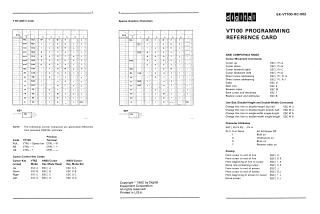
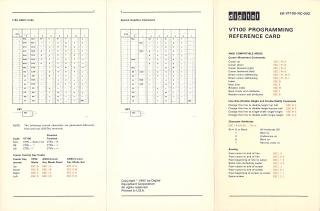
This document is a comprehensive programming reference card for the VT100 terminal, detailing various control characters and escape sequences across multiple functionalities. It provides tables for 7-Bit ASCII and Special Graphics Characters, showing their octal, decimal, and hexadecimal representations.
The card outlines commands for:
- ANSI Compatible Mode: Including cursor movement (up, down, forward, backward, direct addressing), saving/restoring cursor positions and attributes, setting line sizes (double-height, double-width), character attributes (bold, underscore, blink, reverse video), and various screen erasing functions.
- Programmable LEDs: Commands to control the state of the terminal's LEDs.
- Character Sets: Designations for different character sets like UK, USASCII, special graphics, and alternate character ROM.
- Scrolling Region & Tab Stops: Commands to define scrolling regions and manage tab settings.
- Modes: Sequences for setting and resetting various terminal operating modes, such as line feed, cursor key, ANSI/VT52 compatibility, column width, scrolling behavior, screen display (reverse/normal), origin, wraparound, auto repeat, interlace, graphic processing, and keypad modes.
- Reports & Identification: Commands to request and receive status reports (terminal readiness, cursor position) and to identify the terminal's installed options (processor, advanced video, graphics processor).
- Reset & Confidence Tests: Commands to reset the terminal and initiate self-tests (screen fill, power-up diagnostics, data loopback, EIA Modern Control Test).
- VT52 Compatible Mode: A dedicated section listing commands specific to VT52 emulation for cursor control, character set selection, home, reverse line feed, erasing, and direct cursor addressing.
- Auxiliary Keypad Codes: Tables detailing the escape sequences generated by the auxiliary keypad in both VT52 and ANSI numeric and application modes for keys 0-9, mathematical symbols, and PF1-PF4.
The document serves as a quick reference for developers and users needing to program or interact with the VT100 terminal using its command sequences.
Site structure and layout ©2025 Majenko Technologies