PDP-9 Advanced Software System Change Notice Version V4B
Order Number: XX-E8188-4B
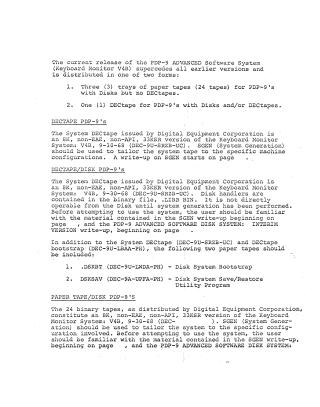
This document details updates and changes to the PDP-9 Advanced Software System, specifically Keyboard Monitor V4B, released on September 30, 1968. It outlines bug fixes, new features, and restrictions across various system components and utilities.
Key areas of update include:
- Distribution & I/O: The system is distributed via paper tapes or DECtape, requiring System Generation (SGEN). New Disk, Magnetic Tape (MTF), and RMØ9 Drum handlers are introduced, with DECtape handlers modified for increased file capacity (up to 56 files) and improved data modes. All I/O handlers now implement the
.WAITR 2, ADDRmonitor call. - Keyboard Monitor (KM9 V4B): New commands for configuring magtape channels, reserving display list memory, and setting character display tables. Improvements to batch mode, file management (GET function), and a major enhancement to IOPS error handling, which now allows user intervention on most errors.
- Programming Utilities: Updates are provided for System Generator (SGEN), UPDATE, DUMP, PATCH, and CHAIN utilities, addressing bugs and adding features like improved file deletion and block management.
- Compilers & Library: MACROA V3A includes expanded buffers but retains design restrictions. FORTRAN IV compilers (F4 V4A, F4A V4A) receive bug fixes, with F4A specifically designed for and restricted to 8K systems. The FORTRAN IV Subroutine Library is enhanced with improved double precision accuracy and new routines for device-independent file operations, elapsed time recording, and adjustable array dimensioning.
- Linking Loader V3A: Now supports overlapping common blocks, enhanced command-string editing, and allows linking MACRO-9 programs with FORTRAN IV common areas.
- Editor V4A: Features numerous block mode improvements, temporary file deletion, backup functionality, and commands for renaming/deleting files, alongside important usage precautions for buffer management and
SCLOSE. - DDT V3A: Can be called without loading user programs, includes
HDR$routine modification, and removes obsolete patch features, with noted restrictions for API-active routines.
Site structure and layout ©2025 Majenko Technologies