PDP-7 Instruction List
Order Number: XX-E86E1-51
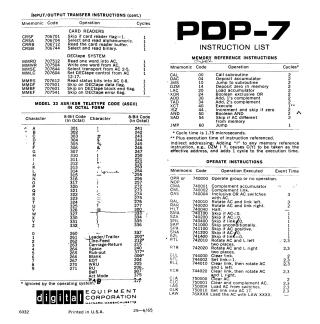
This document serves as a comprehensive instruction list for the PDP-7 computer, detailing various categories of commands along with their mnemonic codes, operational descriptions, and execution cycles or times. The instructions are broadly categorized to cover core functions, peripheral control, and advanced arithmetic operations.
Key sections include:
- Memory Reference Instructions: Fundamental operations for data movement, arithmetic, logical operations, and program control (e.g., LOAD, ADD, JUMP). The base cycle time is specified as 1.75 microseconds, with indirect addressing adding an extra cycle.
- Operate Instructions: Single-word instructions for manipulating the accumulator and link, and for program control.
- Input/Output Transfer Instructions: Extensive commands for controlling a wide array of peripherals, such as card readers, DECtape systems, Model 33 ASR/KSR Teletype (including a detailed ASCII octal code table), perforated tape punch and reader, Teletype keyboard and teleprinter, oscilloscope displays (Type 34A and 30D), general-purpose multiplexer, and analog-to-digital converters.
- EAE (Extended Arithmetic Element) Instructions: Advanced arithmetic and shift operations, including various forms of multiplication, division, fractional arithmetic, and accumulator manipulations.
- Program Interrupt Instructions: Commands for enabling, disabling, and managing program interrupts.
- Real Time Clock Instructions: For controlling and monitoring the system's real-time clock.
- Automatic Priority Interrupt (Type 172) Instructions: For managing prioritized interrupt channels.
- Memory Extension Control (Type 148) Instructions: Commands for controlling and utilizing memory extension features.
Each instruction provides a mnemonic code, a description of its function, and the number of cycles or the time required for its execution, making it a vital reference for programming the PDP-7.
Site structure and layout ©2025 Majenko Technologies