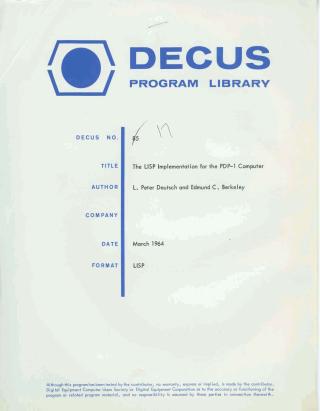
The Lisp Implementation for the PDP-1 Computer
Order Number: US-PL085-PL
| Author | L. Peter Deutsch / Edmund C. Berkeley |
| Language | LISP |
| DECUS No | 01-085 |
This document serves as documentation and a program listing for "Basic PDP-1 LISP," a LISP system implemented for the PDP-1 computer by L. Peter Deutsch and Edmund C. Berkeley in 1963 and 1964.
Summary:
- Overview: The system is a LISP interpreter designed for the PDP-1 computer. It uses a minimum of 2,000 registers and can be scaled up depending on the amount of available core memory.
- Features: It provides a basic subset of functions compatible with the LISP 1.5 system used on the IBM 7090, including support for machine language subroutines via special forms like
XEQandSUBR. It also includes functions for list manipulation, arithmetic, and basic I/O. - Operation: The document explains how to load the system using punched tape, how to interact with the interpreter via typewriter input, and how to utilize sense switches for control.
- Diagnostics: A list of error codes (e.g.,
icd,uss,sce) is provided to help users troubleshoot common issues, such as illegal commands, unbound symbols, or memory overflow. - Technical Details: The document includes a "Part II" which provides a comprehensive macro symbolic program listing of the system, including alphabetic and numeric indexes of the defined symbols, and an explanation of the underlying list structure and memory representation (concise code).
Site structure and layout ©2025 Majenko Technologies