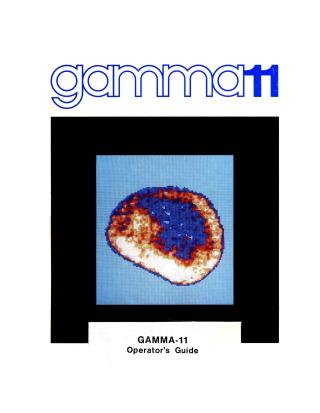
GAMMA-11
Operator's Guide
Order Number: AA-2185B-TC
This document serves as an operator's guide for the GAMMA-11 system, a computer application designed for the acquisition and analysis of gamma-camera data in nuclear medicine departments. Released in January 1978, it supersedes a previous version from August 1976.
The guide outlines the system's operation and its use within the RT-11 Foreground/Background (F/B) operating environment. Key features and functionalities described include:
- System Description: GAMMA-11 acquires and analyzes data from gamma cameras, using the RT-11 file structure for patient data. It can run in a single-job RT-11 system or an F/B system, where data acquisition runs in the foreground, and data analysis or other utility functions can run concurrently in the background.
- Study Types: The system supports various nuclear medicine studies:
- Static Study: Records one or more images of an organ for structural analysis.
- Dynamic Study: Captures sequences of images over time to visualize motion or flow, allowing for the calculation of radioactivity rate curves.
- List Study: Stores unstructured X-Y coordinate data with time-reference marks, which can later be restructured into static or dynamic studies.
- Gate-Synchronized Study: Synchronizes data acquisition with external gate signals (e.g., ECG) for studies like cardiac acquisition.
- Flood Study: A static study used to check and correct for non-uniform gamma camera response, generating a correction matrix.
- Predefined Study: A template to save time by presetting common acquisition parameters for routine studies.
- Hardware Requirements: Specifies minimum hardware, including PDP-11 CPU, memory, terminals, disk controllers (RK05/RK06), and real-time clock.
- Data Acquisition Procedures: Detailed steps for setting up and acquiring patient studies, including defining patient data, camera parameters, and collection parameters, with options for comments and managing disk space.
- Data Analysis Commands: A comprehensive set of tools for processing and visualizing acquired data, covering:
- Image display (full size, minified, isometric, dual display, interpolated).
- Frame manipulation (selection, algebra, rotation, translation, smoothing, isocontouring).
- Contrast enhancement using thresholds and isocount bands.
- Region of Interest (ROI) definition (regular and irregular) and dynamic curve generation.
- Comment editing and keyboard echo-print controls.
- Macro commands for automating data analysis tasks.
- Execution of high-level language programs (BASIC, FORTRAN, FOCAL) directly from GAMMA-11.
- List mode data processing for reframing and storing data.
- Color Display Specifics: Additional analysis commands tailored for color displays, including color table management, interpolation, dual display modes, and dynamic playback of image sequences.
- Slicing: Functionality to examine data patterns by creating horizontal or vertical slices through the matrix and plotting cell-count distributions.
- Flood Correction: Explains how to create and apply flood-correction matrices to compensate for camera irregularities.
- Utilities: Includes file deletion and study transfer capabilities for managing patient data files across different storage devices.
The guide is intended for operators who have a working knowledge of nuclear medicine and gamma cameras, providing illustrative examples and references to other manuals for background information.
Site structure and layout ©2025 Majenko Technologies