ptpser
Order Number: XX-9AACD-81
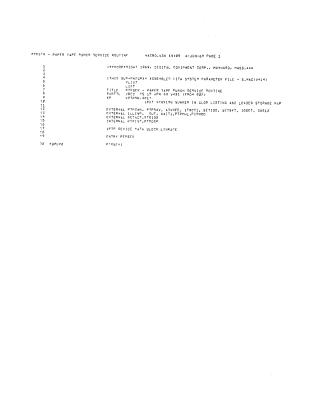
This document is a MACRO assembly language listing for the PTPSER (Paper Tape Punch Service Routine), developed by Digital Equipment Corporation (DEC) in 1969. It is designed for managing and controlling a paper tape punch device, likely for a PDP-series computer.
The routine's primary purpose is to provide low-level, interrupt-driven services for outputting data to paper tape.
Key functionalities and features of PTPSER include:
- Initialization (PTPINI): Setting up the paper tape punch for operation.
- Device Control and Configuration: Defining and managing the PTP Control Register, I/O Status Words, and special ASCII characters. It supports various punching modes, including ASCII, binary, and image binary.
- Output Operations (PTPOUT, PTPINT): Handling the actual data punching, processing characters (including parity, eighth-hole, horizontal/vertical tabs, and form feeds), and managing the device's state during interrupt service.
- Data Structure Management: Manipulating the PTP Device Data Block (PTPDCB), which stores critical information such as data pointers (PTPPTR), device addresses (PTPADR), character counts (PTPCNT), and the current character (PTPCHA).
- Checksum Calculation (PTPBN): A dedicated routine for calculating checksums, particularly used for binary data.
- Buffer Management (PTPADV): Advancing through data buffers, determining byte sizes, and tracking output progress.
- System Integration: Interfacing with other system routines for I/O operations (e.g., IOSET, WAIT1, OUT), saving/restoring context, and setting system parameters.
- Error and Status Handling: Managing device time-out conditions, disconnects, and reporting device status.
Essentially, PTPSER acts as a crucial sub-program, providing the interface between the operating system or applications and the physical paper tape punch to enable reliable data output in various formats.
Site structure and layout ©2025 Majenko Technologies