DEC-10-J00A-D PDP-10 Reference Card 0
Order Number: XX-4677E-29
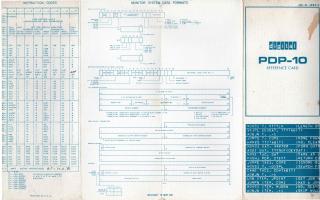
This document is a comprehensive reference card for the Digital PDP-10 computer, detailing its instruction set and various data/word formats.
Key aspects of the document include:
Instruction Codes and List: It provides a detailed list of machine instructions (mnemonics and numerical codes) categorized by function, such as:
- Data Movement: MOV (move), Block Transfer, EXCHange.
- Arithmetic: ADD, SUBtract, MULtiply, DIVide (for both integer and floating-point operations).
- Logical: AND, OR, Xclusive OR, EQuiValence.
- Bit Manipulation: Arithmetic SHift, Logical SHift, ROTate.
- Control Flow: JUMP, SKIP (conditional), HALT, eXeCuTe, PUSH, POP (stack operations).
- Input/Output (I/O): READ, WRITE, INPUT, OUTPUT, and instructions to manage device status and channels.
- Conditional Operations: Instructions based on AC, memory, or various system flags (Overflow, Carry).
Word Formats: It illustrates the bit-level structure of various word types, including:
- Basic Instructions: Layout of instruction codes, register fields (A, F), index register (X), and operand address (Y).
- In-Out Instructions: Specific fields for device codes.
- PC Word: Structure of the Program Counter, including system flags.
- Pointers and Control Words: Formats for Block Transfer (BLT), I/O (BLKI/BLKO, IOWD) pointers, and data channel control words.
- Byte Storage: Definition of how bytes are packed within a 35-bit word, specified by position (P) and size (S).
- Operand Formats: Structures for fixed-point (two's complement binary) and floating-point operands (sign, excess 128 exponent, two's complement fraction).
Monitor System Data Formats: Diagrams and explanations for:
- Device Status Word: Bit definitions for various device states (e.g., interrupt, ready, error, busy).
- Channel Device Control Word: Bits for channel control.
- I/O Parameter Blocks: Structures defining parameters for I/O operations, including file extension, protection, project number, and creation date.
- Buffer Headers: Formats for managing data buffers (address, count, status word).
The document essentially serves as a critical reference for low-level programming and understanding the architecture of the PDP-10 system.
Site structure and layout ©2025 Majenko Technologies