7810xx LCG Product Strategy
Order Number: XX-1C4D4-43
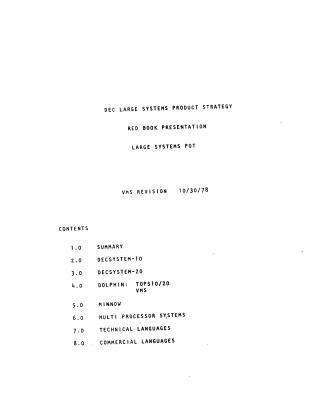
This document outlines Digital Equipment Corporation's (DEC) Large Systems Product Strategy as of October 30, 1978.
Core Strategy & Focus: DEC aims for continued profitable growth in the large systems mainframe business by providing superior cost-performance in interactive, general-purpose computing. The future strategy focuses on small to large-scale mainframe systems optimized for communications-based data processing under a single operating system, emphasizing "superior orchestration" of product capabilities. Key capabilities include interactive computing, ease of use, transparent distributed data processing (including SMP and network gateways), robust databases, very high system availability (fault tolerance), and efficient transaction processing.
Product Evolution & Hardware: The strategy details a transition from current DECSYSTEM-10 and DECSYSTEM-20 systems (KL and KS processors) to future platforms:
- TOPS-20: The primary focus, with continued development for performance, extended addressing, networking, security, and reliability.
- TOPS-10: Minimal investment, intended to sustain the customer base until TOPS-20 can serve as a replacement, while supporting new hardware.
- VMS: Planned as a "Star follow-on engine" for future high-performance systems.
- MINNOW (FY80): A cost-reduced version of the 2020, aiming for distributed computing and pushing into higher-volume markets.
- DOLPHIN (FY81): A high-performance CPU (with future SMP and VMS support) positioned for aggressive new product development and significant cost/performance leadership.
- Hardware Consolidation: KL10E, KS10, 2020, 2040, and 2060 systems are central, with continued investment in multi-processor (SMP) systems.
Market & Competition: DEC targets knowledgeable data processors seeking comprehensive application tools for communications-based data processing. Key customer needs include reduced total cost of ownership, scalable computing, standard software packages, data management, ease of use, high availability, and people productivity. IBM is identified as the dominant competitor, setting industry standards (e.g., SNA, 370 Architecture). DEC aims for a high degree of compatibility and easy interconnectivity with IBM systems. Competition is also noted from mini-makers entering the mainframe space.
Technology & Investment: Technological trends highlight increasing component density, with software becoming the critical differentiator over hardware. Focus areas include natural language interfaces, distributed processing, security, shared data, sophisticated program development tools, and relational databases. DEC plans significant investment in new system development (Minnow, Dolphin), peripherals, operating systems, and languages. Revenue projections show a decline in older KL and KS systems being offset by strong growth from MINNOW and DOLPHIN.
Unresolved Issues: The document notes several unresolved issues, including the strategy for TOPS-10 on new DEC-20 hardware, short-term investments in long-term products (COBOL 79, FORTRAN 77, Distributed Processing, Databases), the phase-over for extended addressing, the detailed TOPS-10 to TOPS-20 migration plan, the DOLPHIN VMS business plan, and specific software implementation plans for transparent networks, distributed databases, and a programmer workbench.
Site structure and layout ©2025 Majenko Technologies