761214 Small Machine R and D
Order Number: XX-2A791-BF
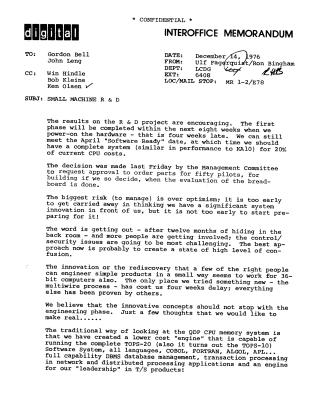
This document, comprising an interoffice memorandum (December 14, 1976) and an accompanying project plan (May 18, 1976), details the "Small Machine R&D" project, code-named "SM-10," at Digital Equipment Corporation (DEC).
Core Purpose & Innovation: The SM-10 project aims to develop a significantly lower-cost, high-performance PDP-10 based computer system. Its primary goal is to achieve KA10 performance at only 20% of current CPU costs, while running the complete TOPS-20/TOPS-10 software system, supporting all major languages, full DBMS, transaction processing, and distributed network applications. The vision is to create a versatile, low-cost "engine" for various uses, including "personal use" systems and establishing "leadership" in time-sharing (T/S) products.
Current Status (as of Dec 1976 Memo): The project is showing encouraging results. The first development phase is expected to conclude within eight weeks, though hardware power-on is four weeks behind schedule. Despite the delay, the team aims to meet an "April 1977 Software Ready" date. The Management Committee has approved ordering parts for 50 pilot units for future evaluation and potential manufacturing.
Development Strategy (from Project Plan): A staged development approach is being used, contrasting with prior simultaneous development efforts:
- Phase I ("The Garage"): Focuses on verifying initial design concepts, producing a running breadboard, and creating a database for Phase II. This phase emphasizes a small, experienced team, minimal interfaces, cost reduction, leveraging existing technology, and avoiding risky new approaches (April 1976 - April 1977).
- Phase II: Aims to verify manufacturability, field support, and marketability. This will involve manufacturing up to 100 units for "friends in the academic and research community" to serve as a field test (January 1977 - December 1977).
- Phase III: Envisions volume shipment (starting January 1978).
Key Process & Product Innovations: Beyond the low-cost hardware, the project explores process innovations. These include designing the machine for a "robot production process" (targeting 30 man-minutes for assembly) and implementing "ultimate remote repair" capabilities (self-diagnosis via an internal 8080, "calling" the field service office, LED indicators, and enabling customer replacement of faulty modules).
Financials & Request: Approximately $100,000 has been spent since April, with an additional $80,000 estimated for systems breadboard check-out. The memo requests $1.5 million in corporate funds for Fiscal Year 1978 to continue R&D activities, both product and process-oriented, with funds to be allocated based on accepted proposals.
Risks: The main risks identified are over-optimism, the challenge of managing control and security as the project gains visibility, a four-week delay caused by the multiwire process (though other elements are proven), potential for development to be more time-consuming than planned, and the risk of extensive redesign in Phase II.
Overall, the project is viewed as an "excellent opportunity to reevaluate a lot of traditional concepts and find a way to break some bottlenecks in our current system."
Site structure and layout ©2025 Majenko Technologies