KXF-10 Exec Mode Nov78
Order Number: XX-A32C2-10
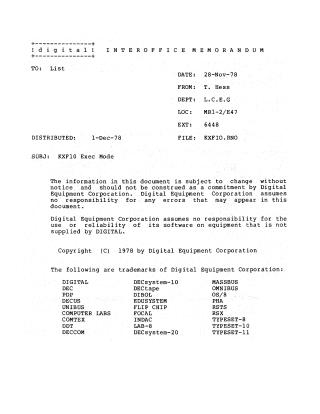
This interoffice memorandum from Digital Equipment Corporation, dated November 28, 1978, describes the KXF10 Exec Mode, focusing on its I/O instructions, virtual addressing capabilities, and process context variables.
Key areas covered include:
Instruction Set:
- I/O Instructions: All I/O instructions (opcodes 700-777) are "ordinary" and share a common format. Opcodes 700-737 are exclusive to Exec Mode for I/O, while 740-777 can be used by both Exec and User modes.
- Internal I/O Instructions: These control the CPU directly without external data transfer. They include functions for:
- Retrieving microcode version and CPU serial number (APRID).
- Controlling processor flags, interrupts, and I/O resets (WRAPR, RDAPR, WRPI, RDPI).
- Loading and reading user and executive mode contexts (WRUBR, RDUBR, WREBR, RDEBR).
- Managing hardware page tables (CLRPT).
- Handling various base registers (SPT, CST, PUR) and time base/interval timers (WRTIM, RDTIM, UPDTIM, WRINT, RDINT).
- Performing various cache sweep operations (e.g., invalidate, validate, unload blocks/pages: SWPIB, SWPVB, SWPUB, SWPIA, SWPVA, SWPUA, SWPIO, SWPVO, SWPUO).
- External I/O Instructions: These facilitate interaction with registers in external devices. They utilize a 27-bit I/O address (Unit ID + Register) and support 36-bit (normal), 16-bit (UNIBUS word), and 8-bit (UNIBUS byte) data transfers. Operations include testing, reading, writing, setting, and clearing bits in I/O device registers (e.g., TIOE/W/B, TION/W/B, RDIO/W/B, WRIO/W/B, BSIO/W/B, BCIO/W/B).
- Special Instructions: PMOVE and PMOVEM are introduced for physical memory moves, designed to enhance efficiency in the monitor.
Virtual Addressing:
- The KXF10 expands virtual address space to 4096 sections, a significant increase from the KL processor's 32 sections, requiring a modified pager data structure.
- It implements TOPS-20 style paging, where virtual addresses are translated into physical page numbers via a "Super" Section Table (SST) located in the Executive Page Table (EPT) or User Page Table (UPT).
- Three pointer types (No Access, Small User, Shared) are defined, with the "Small User" feature optimizing for processes with contiguous memory sections.
Process Context Variables:
- The document proposes a new system for handling process context using an expanded PC flags word.
- It outlines how context variables are managed during context changes, such as monitor calls, page fail traps, and priority interrupt initiations, including storing the "current context" and loading a new one.
EPT/UPT Descriptions:
- Proposed layouts for the Exec Page Table (EPT) and User Page Table (UPT) are provided, highlighting differences from the KL10. These tables include entries for interrupt vectors, console communication regions, TOPS-10 paging, various trap instructions, time base elements, and the "Super" section table.
The document includes a standard Digital Equipment Corporation disclaimer, stating that the information is subject to change, does not constitute a commitment, and that DEC assumes no responsibility for errors or for the use of its software on non-DIGITAL equipment. It also lists several Digital Equipment Corporation trademarks.
Site structure and layout ©2025 Majenko Technologies