M-1090 FRAP Oct60
Order Number: XX-63379-B5
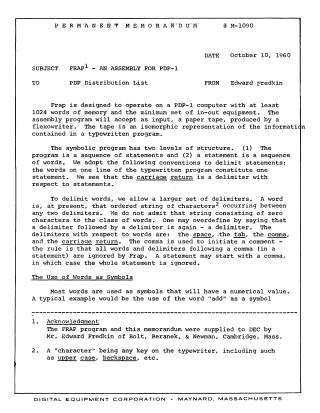
This document describes FRAP (FRAP1), an assembly program designed for the PDP-1 computer, requiring at least 1024 words of memory. It processes paper tape input from a Flexowriter, representing symbolic programs, and produces an output tape in 'read-in mode' for loading into memory.
Programs are structured as sequences of statements, each consisting of words delimited by spaces, tabs, commas, or carriage returns. Words primarily function as symbols with numerical (octal) values, with specific 'control words' guiding the assembly process. The assembler converts these symbols into numerical values, combines them (typically using inclusive OR), and then outputs them.
The assembly typically involves a two-pass process: a first pass to read the symbolic tape and a second pass to generate the output tape. A 'zero pass' is also described for compiling multi-program systems, particularly for handling 'external symbols' (ext).
Key control words include:
opd: Defines operation codes, shifts, and constants.org: Resets the compiler's location counter, specifying where the program will be placed in memory.end: Terminates the program, generates leader/trailer on the output tape, and a final read-in item.loc: Explicitly marks a symbol as a non-label if it's the first word of a statement.+(or&) and-: Specify addition or subtraction instead of inclusive OR for combining values.¢: Represents the current location counter value.con: For concise code representation of characters.pause: Halts assembly until manually continued.fix: Adds definitions to the permanent symbol table.
Sense switches provide various controls, such as enabling listings on the typewriter (SS2), performing the zero pass (SS3), printing the symbol table (SS6), and influencing origin settings (SS1). The document also provides a table of error indications and their remedies.
An addendum details updates, including the generation of 7-hole leader/trailer, refined functionality for Sense Switch 1 (for setting origin from test word), improved handling of ext symbols, and the definition or elimination of several system-specific symbols (e.g., xec, nop, sb0-sb17). The document concludes with a comprehensive list of defined instruction and control symbols with their corresponding octal values.
Site structure and layout ©2025 Majenko Technologies