M-1086 Apr60
Order Number: XX-DFA49-C2
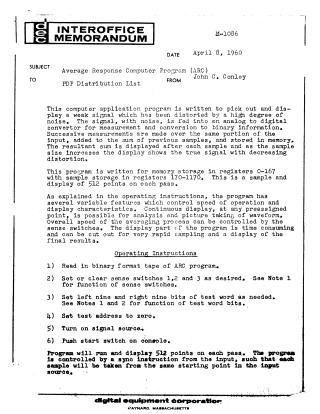
This document describes the "Average Response Computer Program (ARC)" for the PDP computer, designed to extract and display weak analog signals that are obscured by significant noise.
The program works by digitizing the noisy analog input and then repeatedly sampling the same portion of the signal. These successive binary measurements are summed and stored in memory. As more samples are averaged, the noise is progressively reduced, allowing the underlying true signal to emerge and be clearly displayed. The program processes 512 data points per pass.
ARC offers several customizable features:
- Speed and Display Control: Operational speed and display characteristics are controlled via front-panel sense switches (SW1, SW2, SW3). These switches determine the sampling speed (e.g., one sample per point or multiple), the frequency of display updates (after each sample, after a set number of samples, or continuously), and whether sampling is continuous or limited.
- Timing Parameters: Specific bits within a "test word" (bits 9-17 for delay between responses, bits 0-8 for the first measured point) provide further control over timing and delays.
- Optimization: For very rapid data acquisition, the display function can be disabled, allowing the program to run faster and only show the final averaged results.
The document also includes the detailed assembly language listing for the ARC program, specifying memory allocations for the program instructions (registers 0-167) and for sample storage (registers 170-1170), along with operating instructions for loading, configuring, and running the program.
Site structure and layout ©2025 Majenko Technologies