4434487 Disk Format For Secondary Storage System Oct81
Order Number: XX-3DBCF-0E
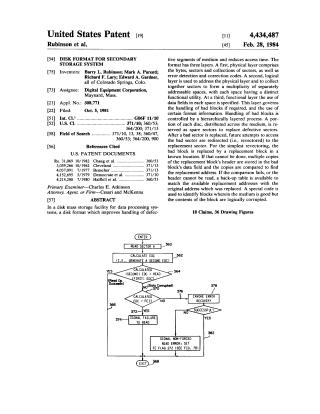
This patent describes a hierarchical disk format and associated methods for secondary storage systems, aiming to improve defective media handling and reduce access time.
The system employs a three-layered format:
- Physical Layer: Defines the basic units (bytes, sectors, collections of sectors) and includes error detection (EDC) and error correction (ECC) codes. Each sector has a header containing its logical address and status.
- Logical Layer: Organizes physical sectors into distinct, addressable spaces:
- Host Application Area (LBNs): User-visible data.
- Replacement and Caching Table (RCT) Area (LBNs): Stores information for bad block replacement.
- Replacement Block Numbers (RBNs): Spare sectors for replacing defective LBNs.
- External Block Numbers (XBNs): Stores formatting information.
- Diagnostic Block Numbers (DBNs): Used for diagnostics. This layer ensures a logically contiguous address space for the host and optimizes sector access based on a hierarchy of "tracks," "groups," and "cylinders."
- Functional Layer: Governs bad block handling and format information.
Key mechanisms of the invention include:
Hierarchical Bad Block Replacement (Revectoring):
- Spare Sectors: A portion of the disk is reserved and evenly distributed as spare sectors.
- Primary Revectoring: For the simplest cases, a bad block's access is redirected to a replacement sector on the same track, implied by the bad block's position.
- Secondary Revectoring: If primary replacement isn't possible, the bad block's data field stores multiple copies of the replacement block's header. These are read and statistically compared to determine the replacement address.
- Tertiary Revectoring: If secondary revectoring fails (e.g., header comparison fails or header unreadable), a backup table (RCT) is searched to match the original bad address with a replacement address.
Forced Error Indicator (FEI): A special code (one's complement of the EDC) is used in the sector header to mark blocks that contain logically corrupted data but reside on physically good media. This distinguishes logical corruption from physical defects, allows for data copying to other physically good sectors, and is cleared upon a successful write.
- Multi-Copy Protection: Critical data structures, such as the Replacement and Caching Table (RCT) and Format Control Table (FCT), are stored in multiple copies across the disk to ensure high reliability.
- Dynamic Formatting: The controller can dynamically adapt to different sector sizes (e.g., 512-byte or 576-byte) based on the specific disk area being accessed.
The system thus provides robust error handling, efficient access time, and a flexible disk organization to manage media imperfections over time.
Site structure and layout ©2025 Majenko Technologies