MPS Brochure Modules
Order Number: XX-E37DD-9D
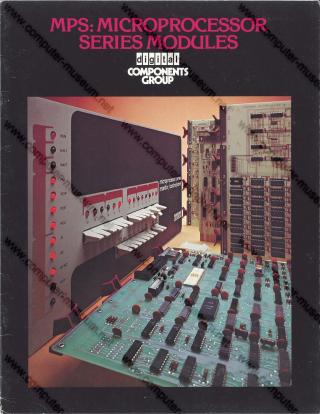
This document introduces the Digital Equipment Corporation's (DEC) MPS: Microprocessor Series Modules, a modular microprocessor system designed to provide low-cost, flexible, and programmable processing and control capabilities.
Key aspects of the MPS Series:
- Purpose: To make computer processing/control available at lower prices, bridging the gap between simple integrated circuits and minicomputers. It aims to replace fixed logic with programmable modules, simplifying design, improving reliability, and reducing costs.
- Components: The series consists of a CPU Module (M7341), various Read/Write Memory Modules (M7344-YA/YB/YC), a Programmable Read-Only Memory (PROM) Module (M7345), an External Event Detection Module (M7346), and a KC341 Monitor/Control Panel. These modules can be configured to form a processing unit with up to 16K words of semiconductor memory.
- Features: The CPU is an 8-bit parallel processor with 48 data-oriented instructions and a 12.5 µs cycle time, capable of directly addressing up to 16K words of memory. The system emphasizes building-block modularity and compatibility with existing DIGITAL logic modules.
- Applications: It targets a wide range of control-oriented functions for Original Equipment Manufacturers (OEMs) and various industries, including industrial control (machine tools, material flow), process control (batch mixing, furnace monitoring), small laboratory automation, data communications (concentrators, processors, intelligent terminals), business machines (OCR, banking), health/education/welfare (environmental control, teaching), and transportation (traffic control, vehicle recognition).
- Software Support: DEC provides a suite of software tools for developing MPS applications, including a Microprocessor Language Editor (MLE), Assembler (MLA), PROM Programmer (MRP), Debugging Program (MDP), Master Tape Duplicator Program (MTD), and Host Loader Program (MHL), often run on a PDP-8 minicomputer or through the control panel.
In essence, the MPS Series offers a powerful yet affordable solution for integrating "smart" processing and control into products and systems that might not justify the cost or complexity of a full-scale minicomputer.
Site structure and layout ©2025 Majenko Technologies