LAT Protocol Dec83
Order Number: XX-3BF6C-CF
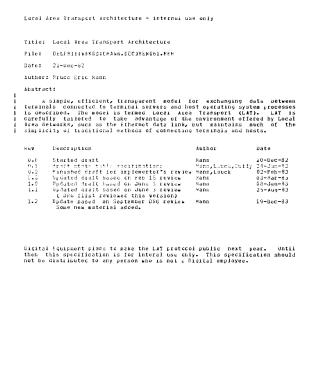
This document describes the Local Area Transport (LAT) architecture, a communication model developed by Digital Equipment Corporation (DEC) for Ethernet-based local area networks (LANs). Initially for internal use, LAT aims to be a simple, efficient, and transparent method for exchanging data between terminals, terminal servers, and host operating system processes.
Key aspects of LAT's design and purpose include:
- Core Purpose: To provide a low-level communication service that enables interoperable implementations for connecting various devices over an Ethernet LAN. Its design prioritizes simplicity.
- Design Philosophy: LAT is tailored to leverage the characteristics of local, non-routable Ethernet environments. It operates on the assumption of asymmetric communication (simplifying host management) and uses a timer-based protocol.
- Reliability over Unreliability: Crucially, LAT builds reliable, bidirectional, sequential, timely, and error-free "virtual circuits" on top of Ethernet's inherently unreliable datagram service. This means it handles data duplication, out-of-order delivery, and potential corruption at its own layers.
- Architectural Layers:
- Virtual Circuit Layer: Responsible for establishing and maintaining virtual circuits between hosts and terminal servers, translating logical names into Ethernet addresses, and managing message exchange.
- Slot Layer: Sits above the virtual circuit layer, providing user session establishment, data transfer, and multiplexing multiple user connections over a single virtual circuit.
- Service Discovery & Management: Host systems periodically advertise their available services via multicast datagrams. Terminal servers listen for these advertisements, allowing users to select and connect to desired services dynamically.
- No Inherent Security: The architecture explicitly states that it does not provide any security features beyond what the Ethernet itself offers; authentication and data link encryption were anticipated but not implemented.
- Flow Control & Error Handling: The protocol incorporates flow control mechanisms to prevent data overflow and includes provisions for detecting and logging "illegal" messages or slots to aid in diagnosing hardware faults and software implementation errors.
- Service Classes: LAT supports different "Service Classes" (e.g., interactive terminals, application terminals), allowing for extensions and specific optimizations tailored to the needs of particular applications.
Site structure and layout ©2025 Majenko Technologies