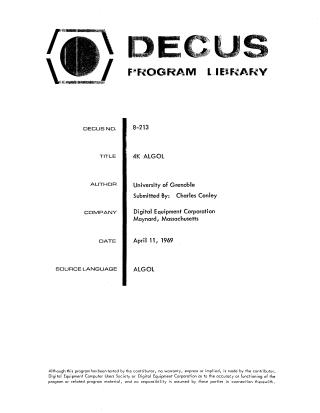
4K ALGOL
Order Number: XX-39F7E-25
| Author | Charles Conley |
| Language | ALGOL |
| DECUS No | 08-213 |
This document is a user manual for 4K ALGOL, also known as ALGOL-8, specifically designed for the Digital Equipment Corporation (DEC) PDP-8 computer (4K or larger memory). Submitted by Charles Conley of DEC and developed by the University of Grenoble in April 1969, it serves as a handbook for users already familiar with ALGOL.
The manual details the specific implementation of Subset ALGOL 60 (IFIP), including additional restrictions tailored for the PDP-8's architecture. Key areas covered include:
- Program Structure: Defining the form of ALGOL-8 programs, including BEGIN/END blocks.
- Elements and Data Types: Explaining integers, real numbers, Boolean types, basic symbols, identifiers (with a four-character significance limit), constants, and one-dimensional arrays.
- Expressions: Detailing arithmetic and Boolean expressions, their operators, priorities, and standard functions (e.g., SQRT, SIN, COS, LN, EXP).
- Statements and Control Flow: Describing assignment, GOTO, FOR (without the 'WHILE' keyword), conditional statements, and the use of labels and comments.
- Input/Output: Instructions for reading and writing data using the ASR-33 Teletype or high-speed paper tape reader/punch, including format specifications.
- Operating Instructions: Comprehensive guides for using the ALGOL-8 compiler and operating system, detailing loading procedures, memory usage, and paper tape formats.
- Diagnostics: Lists of compile-time and execution-time error messages to aid in debugging.
Notable limitations and characteristics of this ALGOL-8 implementation include:
- No user-defined procedures.
- No Boolean arrays.
- Arrays are exclusively one-dimensional.
- Integer values are restricted to a range of ±2040.
- The compiler halts upon detecting the first syntax error.
- It relies on paper tape for source and data I/O.
Appendices provide quick references for basic symbols, program restrictions, error codes, and a summary of commands.
Site structure and layout ©2025 Majenko Technologies