A LISP Interpeter for the PDP-8
Order Number: DECUS-8-102A
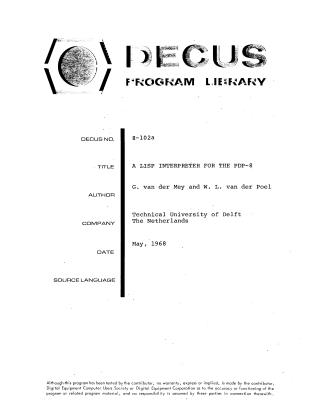
| Author | G. van der Mey / W. L. van der Poel |
| Language | LISP |
| DECUS No | 08-102a |
This document describes a LISP interpreter, DECUS program number 8-102a, designed for the basic PDP-8 computer. Developed by G. van der Mey and W. L. van der Poel at the Technical University of Delft in May 1968, the system operates on a PDP-8 with 4096 words of core storage, an ASR-33 Teletype, and a high-speed reader.
It is an interpreter-based simplification of LISP 1.5, specifically tailored for conversational use and teaching. Despite the PDP-8's small memory, the system offers a general LISP environment with few language restrictions beyond total storage space. Key features include:
- Memory Management: Over half of the core storage is used as list space, with storage dynamically shared between list and push-down space. A LISP cell occupies two core locations.
- Functionality: Supports built-in C...R functions with up to 11 A's or D's, and allows for decimal and octal input/output.
- Ease of Use: Programmers do not need to quote arguments at the top level due to the
EVALQUOTEfunction. - Input Flexibility: Accepts input tapes in both ASCII and CCITT2 (5-hole) codes.
- Control: A "mode number" allows control over printing and the choice of low or high-speed readers.
- Error Handling: Includes a comprehensive set of error stops, with specific indicators for working space or collector stack overflow.
While some advanced LISP 1.5 functions were omitted, they can often be defined using the basic functions provided. The primary limitation is the total available storage. The system can be restarted, reinitialized, and its working space size can be adjusted.
Site structure and layout ©2025 Majenko Technologies