LISP-11
Order Number: XX-FED98-ED
| Author | Jeffret Kodasky |
| Language | MACRO |
| DECUS No | 11-304 |
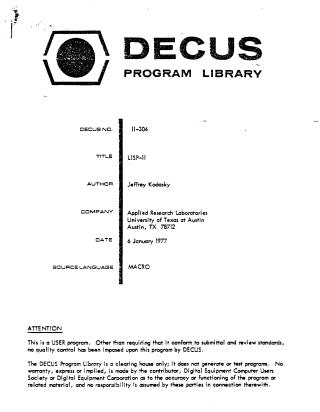
This document details LISP-11, a LISP language interpreter developed by Jeffrey Kodasky at Applied Research Laboratories, University of Texas at Austin, and submitted to the DECUS Program Library in January 1977.
Key aspects of LISP-11:
- Platform & Environment: Designed for PDP-11 series computers running the RT-11 operating system, it functions as an interpretive system in both batch and conversational modes. It requires 16KB of core storage and is written in MACRO assembly language.
- Functionality: It implements 125 LISP functions, categorized into elementary, list manipulation, evaluation control, property list, functional, arithmetic, debugging/error, input/output, string, character, and array functions. These include four types: EXPR, SUBR (machine code), FEXPR, and FSUBR ("special forms" handling unevaluated/arbitrary arguments).
- Memory Management: A crucial feature for its small memory footprint is the conditional assembly option, allowing users to remove up to 60 functions (e.g., string, array, debugging, or math functions) to maximize free space. The document also describes its unique memory layout, where full word space and free space share the same "cell" list structure, and the use of three distinct stacks (general, argument, and linkage). Literal atoms are uniquely stored in an OBLIST using hash buckets.
- Interaction & Customization: Users can configure LISP-11 at startup using command-line switches (e.g., for memory allocation, output format, or enabling "expert" mode). It supports LISP subsystems (predefined function sets loaded from files) and provides detailed instructions for building the interpreter, as well as adding or deleting custom or system functions and variables.
- Error Handling: The system provides recoverable and fatal error messages, along with a backtrace list to aid in debugging.
Site structure and layout ©2025 Majenko Technologies