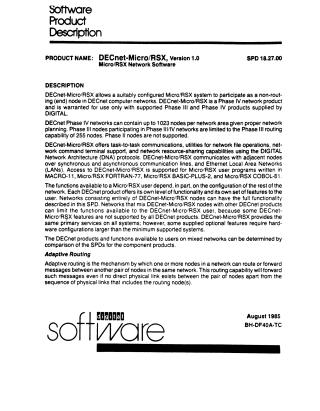
DECnet-Micro/RSX, Version 1.0
Order Number: SPD 18.27.00
DECnet-Micro/RSX, Version 1.0 is network software designed to enable suitably configured Micro/RSX systems to function as non-routing (end) nodes within DIGITAL's DECnet computer networks, specifically Phase IV. It is also compatible with supported Phase III products.
Key capabilities of DECnet-Micro/RSX include:
- Task-to-Task Communication: Allows user programs written in supported languages (MACRO-11, FORTRAN-77, BASIC-PLUS-2, COBOL-81) to exchange messages with other network programs, with optional access control verification.
- Network Resource Access: Provides utilities for transferring sequential ASCII files, submitting and executing remote command files, queuing file operations, and directory listings. It supports file access to and from remote DECnet systems via explicit subroutine calls, handling fixed and variable length records, and ASCII or binary data.
- Network Command Terminal: Supports DIGITAL's Terminal Services Architecture Command Terminal protocol (CTERM) for establishing virtual connections to remote Phase IV DECnet systems, aiding remote program development and resource sharing. It also includes an RMT utility for compatibility with older DECnet-RSX nodes.
- System and Task Loading/Dumping: Facilitates down-line system loading and down-line task loading for RSX-11S nodes from a Micro/RSX file system, and upline dumping of RSX-11S memory images for debugging.
- Network Management: Utilizes the Network Control Program (NCP) for displaying statistical and error information, controlling network components, testing network operation, and logging events.
- Communications: Supports DIGITAL Data Communications Message Protocol (DDCMP) for serial synchronous/asynchronous transmissions (point-to-point and multipoint) and Ethernet Local Area Networks (LANs). It also offers Direct Line Access (DLX) for MACRO-11 tasks to directly control communication lines.
DECnet-Micro/RSX configuration involves trade-offs between cost, performance, and functionality, influenced by factors like CPU type, memory size, communication line characteristics, buffer sizes, message frequency, and local applications. Various communication devices are supported, categorized by their impact on CPU utilization and maximum line speed.
Minimum hardware requirements include an additional 16KW of memory (plus 3KW for Ethernet), 4000 disk blocks, and a Micro/PDP-11/23 or /73 central processor with specific communication devices (e.g., DMV11, DLV11, DEQNA). The prerequisite software is the Micro RSX Operating System Base Kit, with optional support for various Micro/RSX language compilers.
Digital provides a 90-day warranty, various installation services, NETstart Services for setup and training, and different levels of Software Product Service Agreements (DECsupport, BASIC, Self-Maintenance) to maintain the software. Licensing is CPU-specific, with options for distribution, documentation, and software revision rights.
Site structure and layout ©2025 Majenko Technologies