DEC Business Plan Jul57
Order Number: XX-4A91E-76
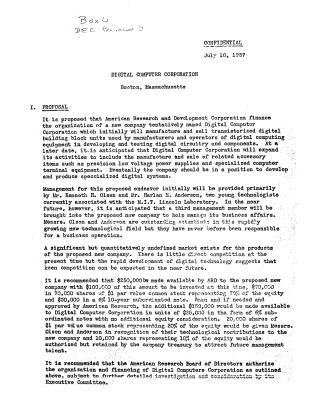
This confidential memorandum from July 10, 1957, proposes that American Research and Development Corporation (ARD) finance the creation of a new company, Digital Computer Corporation (DCC).
I. Proposal & Business Overview: DCC would initially manufacture and sell transistorized digital building block units, developed at M.I.T. Lincoln Laboratory, for use by manufacturers and operators in developing and testing digital circuitry. These units are touted as superior to existing vacuum tube models (e.g., Burroughs) due to greater reliability, higher speed, smaller size, lower cost, and reduced power/cooling requirements. Future plans include expanding to related accessory items like precision low-voltage power supplies and specialized computer terminal equipment, eventually developing and producing complete digital systems.
II. Management: The company's initial management will be led by Kenneth H. Olsen (31) and Harlan E. Anderson (27), both highly skilled technologists from M.I.T. Lincoln Laboratory. They have significant experience in digital technology development, including administrative roles, cost estimating, and project scheduling for government contracts. While they are outstanding scientists, they lack prior business administration experience. Therefore, a third management member with business expertise will be hired, and ARD staff will closely supervise the company's business affairs and fund expenditures during its formative period.
III. Market & Competition: A significant, though currently undefined, market exists for DCC's initial products with little direct competition at present. However, the rapid growth of digital technology is expected to lead to keen future competition. Current competitors, Navigation Equipment Company and Digitronics, Inc., are small and lack DCC's anticipated technological advantages. DCC believes its success will depend on its creative technological competence, aggressive sales, high-quality manufacturing, and adequate financial support.
IV. Financial Requirements & Projections: The proposal requests $250,000 in capital from ARD:
- An initial $100,000 ($70,000 in common stock for 70% equity, $30,000 in a 6% 10-year subordinated note).
- An additional $150,000 would be made available later as 6% subordinated notes, subject to ARD's approval if the company shows initial success.
- The founders, Olsen and Anderson, would receive 20% equity (20,000 shares), with 10% (10,000 shares) reserved for attracting future management talent. DCC projects sales of $196,000 in the first year, growing to $4,050,000 by the fifth year, with major expansion anticipated in special digital systems. The company is forecast to break even in its first year and achieve approximately 10% after-tax profit on net sales by the end of the third year. ARD will nominate the majority of the board of directors and the treasurer, maintaining significant control over the company.
V. Field Investigation & Conclusion: American Research and Development conducted an independent investigation, interviewing supervisors and industry experts. The general consensus was favorable, praising the founders' technical skills and the product's market potential, though some noted the founders' lack of business experience. One dissenting opinion highlighted concerns about insufficient capital and inexperienced management in a highly competitive field.
Despite acknowledging the venture as "speculative and daring," the document concludes that "sound reasons exist for believing that the undertaking can be successful." It recommends that the ARD Board of Directors authorize its Executive Committee to invest up to $250,000 in Digital Computer Corporation, subject to further detailed investigation.
Site structure and layout ©2025 Majenko Technologies