HP3000 analysis Dec71
Order Number: XX-0AEB6-79
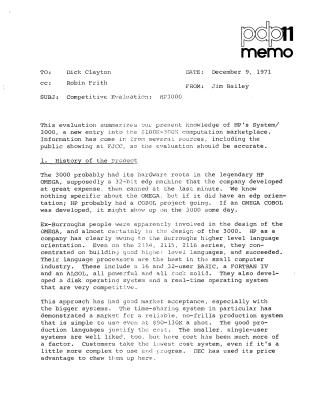
This document is a competitive evaluation of HP's new System/3000, targeting the $100K-$300K computation market.
Key Points:
Product Concept: The HP3000 is a production computing system built around higher-level languages (BASIC, FORTRAN) and a single integrated operating system (MPE) designed to handle batch, time-sharing, and real-time functions simultaneously (similar to DEC's TOPS-10). It features a dedicated 16-bit CPU optimized for compilers and multi-programming (stack-based, no general registers).
Hardware & Memory: A critical concern is the 64K memory limit, which, despite high-speed swapping, could lead to severe bottlenecks, especially with large user programs or data segments. I/O is considered "good enough," but terminal costs are a potential issue.
Software & Languages: HP's strength is its language processors (good FORTRAN, beefed-up BASIC). However, the system's success heavily relies on HP's new, unproven "implementation language" (SPL), a technology new to HP. This introduces significant risk, as any problems with SPL could delay development and impact code efficiency, crucial for managing the 64K memory.
Implementation Schedule & Risks: HP is quoting a one-year delivery, but the document predicts the software will be late and "flaky" initially. This is due to HP's inexperience with complex, integrated multi-function operating systems and their heavy, perhaps overconfident, reliance on SPL for rapid development. The computer division is also seen as "spread thin."
Marketing Strategy: HP is aggressively selling the System/3000, targeting education and large industrial accounts.
DEC's Strategy: DEC should not badmouth the HP3000's specifications or claim it won't run, as HP has a track record of quality software. Instead, DEC should focus on:
- The high probability of delayed software delivery.
- HP being spread thin on this ambitious project.
- The tightly integrated design, meaning if one component fails, the entire system is unusable (unlike DEC's more modular offerings).
- HP's lack of experience in building such a complex, multi-function operating system.
- Customers should be advised to hold off on commitments or avoid the System/3000 altogether.
Site structure and layout ©2025 Majenko Technologies