2M+ Market Slides Apr86
Order Number: XX-E4B05-1C
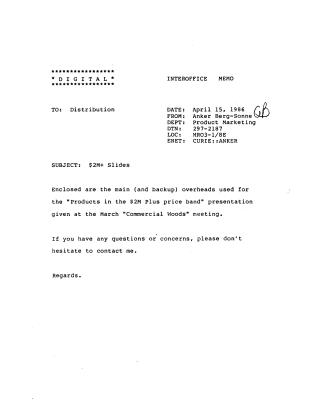
This document is an interoffice memo from Anker Berg-Sonne dated April 15, 1986, enclosing slides for a presentation on "Products in the $2M Plus price band" (high-end mainframe systems).
Summary:
The presentation outlines Digital's strategy, market analysis, and challenges in entering the $2M+ mainframe market, a segment dominated by IBM.
Key Findings & Market Overview:
- Market Size: A large market, projected to be $20 billion in 1990 (24% of the total computer market), growing at a relatively low 7% CAGR overall. The technical segment within this market is smaller ($4 billion in 1990) but has higher growth (15% CAGR).
- Dominance: IBM and IBM-compatible manufacturers (PCMs) account for a massive 87% of the market revenue, with IBM alone holding 73% in 1985. Digital currently has 0% market share in this segment.
- Purchasing Patterns: The $2M+ mainframe purchases are overwhelmingly for replacements or additions to existing installations (87%), with no new initial purchases at this price point. This means Digital must capture market share from entrenched competitors.
- Applications: Primarily driven by traditional commercial production applications (93%), but scientific and professional applications also exist.
Digital's Opportunity & Goals:
- Despite IBM's entrenched dominance, Digital believes it can achieve a 6-8% market share by 1995.
- This entry is considered a long-term business decision, not solely a product decision, requiring a substantial $1 billion cash investment with an estimated 10-year recovery period.
Required Investments & Capabilities: To succeed, Digital needs to invest in:
- Applications: Production system applications, transaction processing, and scientific application performance (including vector processing).
- System Performance: High disk and floating-point performance, balanced system performance (MIPS, MFLOPS), and single-channel disk I/O.
- Reliability: Significantly improved system and peripheral reliability (addressing perceived short MTBF and long MTTR).
- Sales & Support: Project-oriented sales teams, dedicated field applications support, and the ability to provide "fail-safe" service.
- Software: Investments in core software (e.g., TP, database) and VAX Fortran compatibility.
- Image: Shifting its perception from a "mini" company to a viable "business partner" and commercial vendor.
Barriers & Risks:
- Perceived Weaknesses: Digital's reputation for poor hardware reliability and being difficult to do business with, compounded by a "mini" mentality preventing it from being seen as a mainframe provider.
- IBM's Reaction: A significant risk is IBM's anticipated aggressive retaliation, including potential drastic price cuts (up to 40-50% in a "serious competition" scenario) and accelerated product introductions (e.g., 4391/SUMMIT in 1989 instead of 1990).
- Competition: Beyond IBM, competition from Japanese vendors (Fujitsu, Hitachi) is also a factor.
- High Stakes: Limited success could result in substantial penalties, given the large investment and long recovery period.
In essence, the document outlines a high-stakes, long-term strategic move for Digital to enter the top tier of the computing market, requiring massive investment and overcoming significant technical and market perception barriers against a dominant incumbent.
Site structure and layout ©2025 Majenko Technologies