630 Data Communication System Apr64
Order Number: XX-9501F-F5
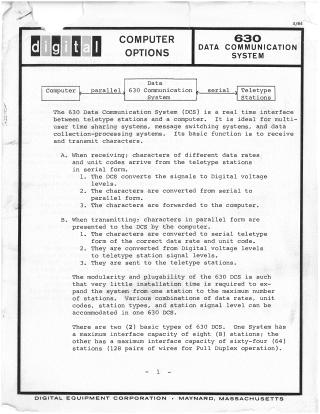
The 630 Data Communication System (DCS) is a real-time interface connecting teletype stations to a computer, ideal for multi-user time-sharing, message switching, and data collection systems. Its primary function is to manage character reception and transmission.
Core Functionality:
- Receiving: Converts serial teletype signals into digital voltage levels, then to parallel form for computer processing.
- Transmitting: Converts parallel characters from the computer into serial teletype format (with correct data rate and unit code) for output to stations.
Key Components:
- Type 631 Data Line Interface: Converts signal levels between teletype stations (e.g., 60 mA, 120V) and the computer's digital logic, operating up to 300 baud.
- Type 632 Send/Receive Group: Manages character conversion between serial and parallel forms. It also mixes received characters from multiple stations and signals the control unit when a station needs service.
- Control Units:
- Type 634 Basic Control: Used for smaller systems (up to 8 stations), interpreting computer instructions, forwarding characters, and requesting service.
- Type 633 Flag Scanner: Used for larger systems (up to 64 stations), rapidly scanning for and identifying stations that require service, then notifying the computer.
Capabilities & Modularity: The 630 DCS is highly modular, allowing easy expansion from one to 64 stations (requiring 128 wires for Full Duplex operation). It can accommodate various data rates, unit codes, and station types within a single system. Different models of its components (e.g., 631A, 632A-E, 633A-T, 634A-T) are designed for compatibility with specific PDP computer models (PDP-1, PDP-4, PDP-5, PDP-6).
Programming & Operation: Service requests from teletype stations are signaled to the computer via "flags" set by the Send/Receive Group. The computer then uses specific input/output instructions to identify the requesting station (either by polling or via the Flag Scanner) and transfer data. Timely character handling is critical for maximum data rates. The system supports features like echo checking and operator intervention through specific programming techniques.
Applications: The 630 DCS was implemented in various applications, including data collection systems (e.g., KEYDATA Corp.), time-sharing systems (e.g., Systems Development Corp.), and medical communication systems, demonstrating its role in handling multi-station teletype traffic.
Site structure and layout ©2025 Majenko Technologies