DEC-VMS-SecivesFor-PC
Order Number: XX-FFD2B-CA
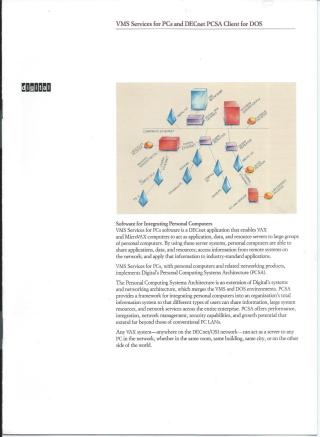
This document describes Digital's VMS Services for PCs and the DECnet PCSA Client for DOS, a comprehensive solution designed to integrate personal computers (running DOS and MS-Windows) into a VAX/VMS and DECnet enterprise-wide network environment. This integration is achieved through Digital's Personal Computing Systems Architecture (PCSA).
Key aspects of the solution include:
- Architecture: PCSA extends Digital's existing systems and networking architecture, merging VMS and DOS environments. It operates on a client-server model, where VAX and MicroVAX systems act as application, data, and resource servers using "VMS Services for PCs" software, and personal computers act as clients using "DECnet PCSA Client for DOS" software.
- Network Foundation: Leveraging DECnet, the system provides a single, complete network where every PC is treated as a true peer, capable of communicating directly with any other system on the local or wide area network.
- Resource Sharing: PCs gain direct, system-wide access to information and resources. This includes:
- File Services: PCs can access remote DOS file systems on VAX servers, with files appearing as local DOS disk drives. Both DOS and VMS users can share and access these files.
- Disk Services: High-performance, DOS-formatted virtual disks hosted on VAX servers are accessible to PCs.
- Print Services: PC and VAX users can share network-attached printers, VAX server-attached printers, or those connected to terminal servers.
- Application Sharing: VAX and MicroVAX systems can act as servers for applications, allowing PCs to run applications and access data across the network.
- Management & Security: The solution simplifies end-user computing management. It allows for:
- Remote Booting: PCs can start up (boot) from the network, with client software residing on the server.
- Centralized Management: Provides VAX-based management for PC resources, including controlling simultaneous client connections, tracking application usage, and monitoring network events.
- Security: Offers VMS-level security, including passwords and Access Control Lists (ACLs), for network file, disk, and print resources.
- User Experience & Integration:
- Maintains a familiar DOS and MS-Windows user interface.
- Provides PCMAIL for network communication (PC-to-PC, PC-to-VMS MAIL).
- Includes PC DECwindows Display Facility (X Window System interface) to display remote VMS/ULTRIX applications on the PC.
- Offers VT220/VT320 terminal emulation for multiple terminal sessions to VAX or other host systems.
- Supports file transfer services between PCs and other non-DOS DECnet nodes.
- Offers DOS operating system enhancements like backup/restore and print screen capabilities.
- Scalability & Flexibility: Any VAX system, regardless of location on the DECnet/OSI network, can function as a server. The architecture supports a wide variety of network topologies and facilitates flexible, incremental growth of PC LANs. VAX systems serving PCs can also continue to run VMS applications.
Digital emphasizes comprehensive services, including implementation support (PCSA DECstart Service) and ongoing maintenance, to ensure successful integration and operation.
Site structure and layout ©2025 Majenko Technologies