DEC-TheConsultant
Order Number: XX-2B4CA-C1
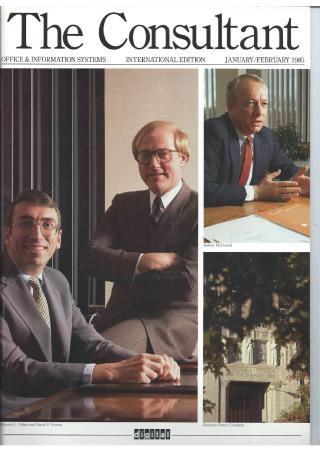
This document is the January/February 1985 issue of "The Consultant" magazine, focusing on office and information systems. It explores the evolving role of information technology (IT) in businesses, presenting it as a strategic asset crucial for future competitiveness.
Key themes and contributions include:
- Strategic Evolution of IT: Richard L. Nolan discusses the shift from the traditional "DP Era" to the "Micro Era," emphasizing the need for "Readaptive Strategies" that foster both efficiency and innovation. He introduces a "Stages Framework" for IT adoption, highlighting the critical stages of integration, architecture design, and "demassing" (organizational restructuring). Nolan also advocates for a new "Computer Functional Executive" role to lead this transformation and suggests learning from "breakaway companies" that strategically integrate IT.
- IT as an Investment and Asset: David P. Norton argues that IT should be treated as a strategic investment rather than just an expense. He points out the inadequacy of outdated financial management techniques for IT and proposes new structures for strategic capital allocation and asset management. Norton identifies three business objectives for IT investment (improving productivity, creating competitive advantage, enhancing management effectiveness) and introduces "Grey Cells" as a method to prioritize investment areas, suggesting a potential ROI closer to 10 times the investment.
- Implementing Office Technology: Robert McDowell stresses that advanced office systems fundamentally change how people work and highlights the importance of managing this change effectively. He advocates for "structured pilot studies" to understand organizational needs, evaluate technology, and measure its impact. McDowell outlines six "musts" for successful IT implementation: top management commitment, serious planning, adequate training and support, clear communication, rigorous testing (via pilots), and thorough cost-benefit analysis.
- Alabama Power Case Study: The magazine features Alabama Power Company as a real-world example. The company is undertaking a pilot project to assess user and system needs for a fully integrated telecommunications, data processing, and office information system, demonstrating early cost and time savings and prompting managers to plan for future organizational changes due to IT.
In essence, the document urges executives in the mid-1980s to strategically embrace and manage information technology as a core business function, moving beyond treating it as a mere expense, to ensure competitiveness in a rapidly changing global landscape.
Site structure and layout ©2025 Majenko Technologies