DEC-Professionan300Series
Order Number: XX-901EA-90
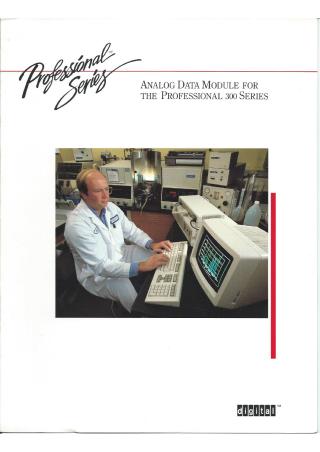
This document describes the Analog Data Module (ADM), a peripheral designed for Digital Equipment Corporation's Professional 300 Series computers (specifically the Professional 350 and 380).
Key features and functions include:
- High-Accuracy Analog Data Acquisition: Provides 8 true differential analog input channels with a 16-bit analog-to-digital converter, capable of handling signals from microvolts to 5 volts. It includes a Programmable Gain Amplifier (with auto-ranging up to 132dB dynamic range) and self-calibration for enhanced precision.
- Digital Input/Output: Features 8-bit parallel digital I/O ports for handshaking, instrument control, and digital data transfers, allowing synchronization with analog data.
- Real-Time Capabilities: Incorporates an on-board programmable real-time clock for precise timing of data acquisition and a First-In, First-Out (FIFO) buffer memory to prevent data loss during high-speed acquisition or when the host computer is busy.
- Connectivity: Connects to the Professional via the Real Time Interface (RTI) parallel digital port, allowing concurrent use of RTI's serial and IEEE-488 bus ports.
- Software Support: Supported by the Professional Real Time Interface Library (PRTIL), which provides high-level subroutines callable from FORTRAN, BASIC-PLUS-2, or PASCAL. This enables users to control experiments, acquire/process data, plot findings, and generate reports, with optional integration into RS/1 for advanced data analysis.
- Benefits: Enhances the accuracy and resolution of collected data, automates data acquisition from instruments, prevents data loss, and improves convenience for application development in scientific and laboratory environments.
The ADM is a separate module that requires the Real Time Interface (RTI) hardware and specific software toolkits for programming. It is supported by Digital Equipment Corporation's hardware, software, and training services.
Site structure and layout ©2025 Majenko Technologies