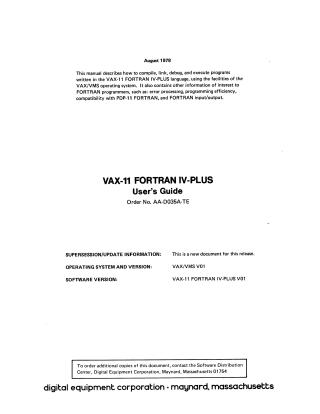
VAX-11 Fortran IV-Plus User's Guide
Order Number: AA-DO35A-TE
This document, the "VAX-11 FORTRAN IV-PLUS User's Guide" (August 1978, Order No. AA-DO35A-TE), is a comprehensive manual for programmers on how to develop, compile, link, debug, and execute programs written in the VAX-11 FORTRAN IV-PLUS language using the VAX/VMS operating system (V01).
Intended Audience: It is primarily for FORTRAN programmers with a working knowledge of the language. While detailed VAX/VMS knowledge is helpful, it's not always essential, though some advanced topics (like condition handling) require a deeper understanding of the operating system.
Key areas covered in the manual include:
- Program Development Lifecycle: How to compile, link, and execute FORTRAN programs, including details on file specifications, command qualifiers, and managing output files.
- Debugging: In-depth guidance on using the VAX-11 Symbolic Debugger to find and correct errors, covering debugger commands, setting breakpoints, examining and modifying memory locations, and understanding the effects of compiler optimization on debugging.
- FORTRAN Input/Output (I/O): Detailed information on VAX/VMS file specifications, logical names, file characteristics (organization and record access), record structures,
OPENstatement keywords, and interprocess communication via mailboxes and remote computers (DECnet-VAX). - Character Data: Explanations and examples of character data manipulation, including substrings, string building, character constants, declarations, and character library functions.
- FORTRAN Call Conventions: Describes how FORTRAN procedures are called, including argument passing mechanisms (
%VAL,%REF,%DESCR), function return values, and methods for calling VAX/VMS system services. - Error Processing and Condition Handlers: Covers run-time library default error processing,
ERR=andEND=transfers in I/O statements, and the VAX-11 Condition Handling Facility for user-written error handling routines. - FORTRAN System Environment and Programming Efficiency: Discusses the relationship between VAX-11 FORTRAN IV-PLUS and the VAX-11 system, focusing on program section usage, storage allocation, data types (integer, byte, floating point), DO loops, and various compiler optimization techniques to write efficient programs.
- Compatibility: An overview of differences and compatibility considerations between VAX-11 FORTRAN IV-PLUS and PDP-11 FORTRAN, including language differences, run-time support, and utility subroutines.
The document also includes appendices summarizing FORTRAN data representation, diagnostic messages from the compiler and run-time library, and system subroutines.
Site structure and layout ©2025 Majenko Technologies