DEC-ClusterForWindowsNT
Order Number: XX-4EC69-F0
This document describes "Digital Clusters for Windows NT," a high-availability solution designed to ensure maximum uptime and continuous operation for critical client/server applications.
Key Concepts and Features:
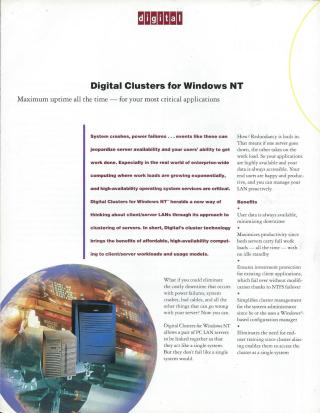
- Clustering: It links two Windows NT PC LAN servers to function as a single, highly available system, eliminating single points of failure common in traditional server setups.
- High Availability: Achieved through redundant components like shared storage, a second network interconnect (Ethernet/FDDI), and redundant data paths. If one server experiences a crash, power failure, or other issue, the other server automatically takes over its workload.
- Failover Manager: The core component that monitors for events (e.g., server or SCSI bus failure) and initiates automatic failover, redirecting services and clients to the operational server.
- Workload Balancing: While files and databases are typically assigned to one server, the system can balance workloads and relocate only affected resources during a failover. It also supports "failover groups" for related services (e.g., SQL Server and Oracle).
- Seamless User Experience: From the end-user's perspective, the cluster appears as a single system, requiring no retraining. Client applications fail over seamlessly without modification.
- Simplified Management: System administrators can manage the cluster using a Windows-based configuration manager.
- Scalability: Supports incremental addition of CPU, I/O, and storage, and is compatible with external RAID subsystems.
- Proactive Maintenance: Allows for manual failover, enabling preventive maintenance and system upgrades without disrupting user services.
- Industry Standards: Built on industry-standard hardware and software components, designed specifically for the Windows NT environment.
Benefits:
- Minimizes costly downtime and ensures user data is always available.
- Maximizes productivity by keeping both servers active and carrying full workloads, avoiding idle standby.
- Protects existing investment in client applications.
- Simplifies administration and eliminates the need for end-user training.
- Provides enterprise-grade availability for growing client/server workloads in a cost-effective manner.
Site structure and layout ©2025 Majenko Technologies