The Pal8 Assembler and Fortran Iv
Order Number: XX-XXXXX-XX
This document contains two main sections providing technical documentation for programming tools on the OS/78 operating system:
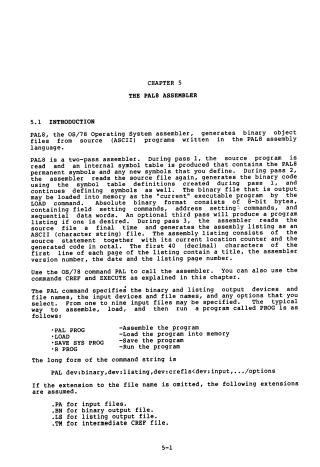
Chapter 5: The PAL8 Assembler
- Overview: PAL8 is a two-pass assembler that converts ASCII source programs into binary object files.
- Operation: Users can assemble, load, and run programs using commands like
PAL,LOAD,SAVE, andR. The assembler supports multiple input files and uses specific file extensions (e.g.,.PA,.BN,.LS). - Features: It includes a comprehensive instruction set (memory reference, microinstructions), supports symbol table management (including user-defined symbols and direct assignments), handles literal and link generation, and provides extensive error reporting.
- Pseudo-operators: The assembler includes several directives for controlling assembly, such as
FIELDfor extended memory,RELOCfor code relocation,ZBLOCKfor memory reservation, and conditional assembly pseudo-ops.
Chapter 7: FORTRAN IV
- Overview: This chapter describes the FORTRAN IV programming system, which includes a compiler, loader, run-time system, and library.
- Workflow: Creating and running a FORTRAN program involves using the Editor to write source code, the
COMPILEcommand to generate relocatable code, theLOADcommand to link modules and assign memory, and theEXECUTEcommand to run the final image. - Language Syntax: The document covers FORTRAN language elements, including data types (integer, real, logical, octal), constants, variables, array declarations, and expression evaluation hierarchies.
- Control Statements: Detailed explanations are provided for control flow statements, including various forms of
GOTO(unconditional, computed, assigned),IFstatements (arithmetic and logical), andDOloops. - I/O Operations: Comprehensive information on input/output management is provided, including
READ,WRITE,DEFINE FILE,BACKSPACE,ENDFILE, andREWINDstatements, along with extensive detail onFORMATstatements and field descriptors for data editing. - Library Functions: The document concludes with descriptions of available library functions and subroutines (mathematical, trigonometric, and utility routines).
Site structure and layout ©2025 Majenko Technologies