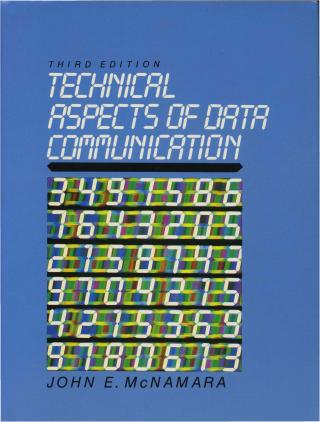
McNamara Technical Aspects of Data Communications 3ed 1988
Order Number: XX-DC34B-2E
"Technical Aspects of Data Communication, Third Edition," by John E. McNamara, is a comprehensive textbook designed to provide an in-depth understanding of data communication systems from a technical perspective. It bridges the gap between high-level system concepts and detailed hardware specifications, targeting individuals involved in designing, purchasing, or programming data communication hardware and software.
The book systematically covers fundamental concepts and evolving technologies in data communication:
- Foundational Concepts: It begins with basic asynchronous communication principles, including parallel and serial transmission, the role of START/STOP bits, and the architecture and programming of Universal Asynchronous Receiver/Transmitters (UARTs).
- Interface Standards: A significant portion is dedicated to widely adopted interface standards, such as EIA-232-D, and newer standards like EIA-422-A, EIA-423-A, and EIA-530. It also covers international CCITT recommendations (V.24, V.25, X.20, X.21) concerning electrical characteristics and functional definitions.
- Modems and Transmission Media: The text explores various types of modems (asynchronous, synchronous, high-speed, error-correcting, split-speed) for both private (leased) lines and switched telephone networks, detailing modulation processes (FSK, phase modulation, trellis coding) and control signals. New material includes modern high-speed and error-correcting modems.
- Error Detection & Protocols: It thoroughly explains error detection methods like parity checks (VRC, LRC) and Cyclic Redundancy Checks (CRC), including their mathematical basis and hardware/software implementations. It introduces the ISO Layered Model of protocols and then delves into specific data link layer protocols: character-oriented (BISYNC), byte count-oriented (DDCMP, Kermit), and bit-oriented (SDLC).
- Network Architectures & Systems: The document provides historical context and technical details on telephone switching systems, automatic calling units, multiplexers (including advanced features like DMA and FIFO buffering), digital transmission (e.g., T1 carrier, clear channel), packet switching (X.25, Datapac), and the Integrated Services Digital Network (ISDN). The section on Local Area Networks (LANs) is revised, discussing topologies (star, ring, bus) and access control methods (polling, tokens, ALOHA, CSMA/CD).
- Practical Considerations: Throughout the book, practical aspects such as noise, distortion, cable capacitance, ground potential differences, and maintenance features are discussed, along with how various hardware and software solutions address these challenges.
The appendices offer valuable reference information on speed versus distance relationships, modem options, communication codes (Baudot, ASCII), USART functions, channel conditioning, and interface connector pinning.
Site structure and layout ©2025 Majenko Technologies