Lavington Early British Computers 1980
Order Number: XX-00514-69
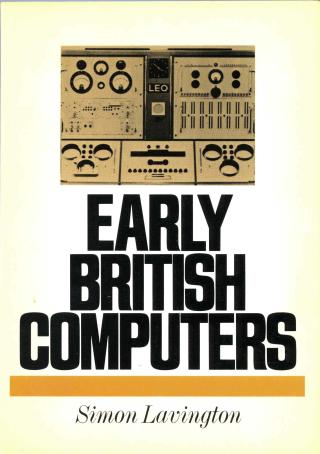
This document, "Early British Computers" by Simon Lavington, provides a historical account of the development of computers in the United Kingdom, primarily focusing on the decade between 1945 and 1955, and tracing the subsequent growth of the indigenous British computer industry up to the early 1960s.
The book defines the evolution of the "computer" from a human clerk to the "universal stored-program digital computer" that emerged after 1945, acknowledging Charles Babbage's foundational ideas. It covers the crucial role of wartime advancements, such as the highly secretive COLOSSUS code-cracking machines, which proved the feasibility of reliable, large-scale electronic digital computation using thermionic valves.
Lavington details the technological challenges of the era, including the limitations of valves and the critical search for effective storage solutions like mercury delay lines and the British-invented Williams tubes (which influenced early American designs). The narrative highlights the significant contributions of key British institutions and companies:
- Universities: Manchester University developed the "world's first stored-program computer" (the Manchester Mark I, 1948) and later pioneered transistor computers like MUSE/ATLAS, introducing concepts such as index registers. Cambridge University created EDSAC (1949), known for its reliable computing service, and its pioneering work in software, including subroutine libraries and microprogram control.
- Government Research Establishments: The National Physical Laboratory (NPL) was home to Alan Turing's original ACE design and its pilot model (Pilot ACE). The Post Office Research Station and Telecommunications Research Establishment (TRE) contributed to COLOSSUS and later defense-focused machines like MOSAIC and TREAC.
- Commercial Enterprises: The book details the emergence of British computer manufacturers, including Elliott Brothers (NICHOLAS, 400 series), J. Lyons & Co. (who developed LEO, a pioneer in business data processing), English Electric (DEUCE, KDF9), and Ferranti (Mark I, PEGASUS, MERCURY). It traces the mergers and consolidations that eventually led to the formation of ICT and later ICL, bringing major British manufacturers under one roof.
The document also touches upon the unique challenges of early programming, the transition from valve-based to transistor-based machines, and contextualizes British developments by comparing them with contemporary American efforts (e.g., ENIAC, UNIVAC). A recurring theme is the impressive innovation driven by individual British engineers and scientists, often in the face of limited central coordination and austere post-war economic conditions.
Complete with technical specifications and a comprehensive bibliography, the book serves as an invaluable resource for understanding the formative years of digital computing in the UK.
Site structure and layout ©2025 Majenko Technologies