Dibol Compiler (Comp)
Order Number: XX-XXXXX-XX
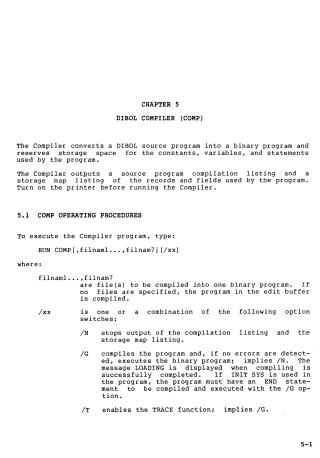
This document serves as the technical documentation for the DIBOL Compiler (COMP). The compiler is responsible for converting DIBOL source programs into executable binary programs and reserving storage for constants, variables, and statements.
Key Operating Procedures:
- The compiler is executed using the command:
RUN COMP[,filnam1...,filnam7][/xx] - Various option switches are available to control output and execution, including:
/N: Suppresses compilation and storage map listings./G: Compiles and executes the program if no errors are found./T: Enables the TRACE function./D: Transfers control to the debugger (DDT)./O: Creates a more memory-efficient binary program.
Compiler Features and Output:
- The compiler generates a two-part compilation listing (Data Division and Procedure Division) and a storage map.
- Errors are flagged in the source listing with a caret (^) and described in the storage map.
- The document provides detailed explanations for specific compiler error messages, ranging from syntax errors to memory constraints (e.g., "PROGRAM TOO BIG" or "TOO MANY SYMBOLS").
Additional Features:
- Conditional Compilation (CCP): Allows for the inclusion of specific code segments based on conditional flags, often used for debugging.
- Memory Management: The document details how memory is allocated for variables, records, and literals, providing a formula for calculating the number of words of code generated by various DIBOL statements.
Site structure and layout ©2025 Majenko Technologies