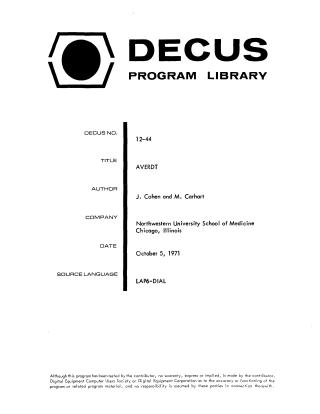
Averdt
Order Number: XX-XXXXX-XX
This document serves as the program library write-up for "AVERDT," a program designed for the Northwestern University School of Medicine (dated October 1971). AVERDT is used to measure readiness potentials by averaging analog EEG data with a delayed trigger.
Key features and functions include:
- Data Processing: It continuously reads EEG data until a trigger pulse is received, saving the preceding data points to compile a 400-point epoch.
- Operations: The program supports averaging across 1, 2, 4, 8, 16, or 32 trials.
- User Controls: It utilizes specific teletype parameters, relay states, sense switches, and keyboard interrupts to manage trial variables, display data on an oscilloscope, and handle tape operations.
- Flexibility: Users can modify parameters such as address delay, epoch length, stimulus delay, and threshold levels via keyboard interrupts during operation.
Site structure and layout ©2025 Majenko Technologies