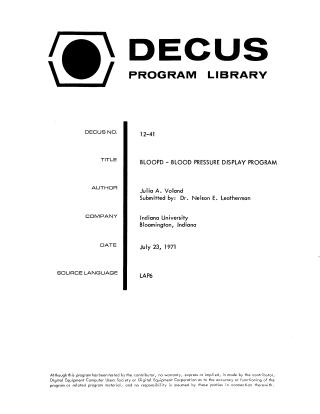
Bloopd - Blood Pressure Display Program
Order Number: XX-XXXXX-XX
Summary
The "BLOOPD - Blood Pressure Display Program" is a software tool developed at Indiana University in 1971 for use on PDP-12A or LINC-8 computers. It serves primarily as a visual aid for monitoring blood pressure in a research setting.
Key Features and Functions:
- Data Visualization: It displays blood pressure waveforms on an oscilloscope and provides digitized values for four blood pressure parameters (systolic, diastolic, pulsatile, and mean) on a teletype.
- Operational Modes: Users can select between calibrating the system, viewing live waveforms, displaying digitized numerical values, or printing the data. An "alternate" mode allows the user to switch between the waveform and digitized values.
- Peak Detection and Calibration: The program includes routines to calibrate pressure inputs using a transducer, and advanced peak detection logic that utilizes self-adapting thresholds to filter out noise and the dicrotic notch.
- Technical Implementation: Written in the LAP6 source language, the program utilizes the FLOS floating-point package for its calculations and relies on specific memory fields in the computer for data storage and instruction routines.
- User Control: The program provides interactive control via teletype inputs, allowing users to adjust display speeds and system settings while the program is running.
Site structure and layout ©2025 Majenko Technologies