DECUS 12 BIT SPECIAL INTEREST GROUP NEWSLETTER
Order Number: US-12B22-SG
| Issue | 22 |
This DECUS Newsletter (May 1977, Number 22) covers a range of topics including administrative announcements, technical notes, bug reports, and a lengthy comparison of OS/8 programming languages.
Administrative and General Information:
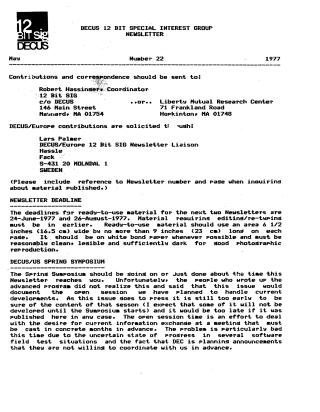
- Contact information for contributions to the 12 Bit SIG Newsletter (Robert Hassinger, Lars Palmer for DECUS/Europe).
- Deadlines for upcoming newsletters are June 24, 1977, and August 26, 1977, with guidelines for ready-to-use material.
- An update on the DECUS/US Spring Symposium notes difficulties in providing real-time information due to planning constraints and undisclosed DEC announcements, highlighting the need for better current information exchange.
- The European DECUS Symposium is noted to be shaping up well with papers, workshops, and training seminars.
Technical Notes and User Contributions:
- Unsigned Compares on PDP-8/12: Ed Steinberger provides detailed assembly code examples for performing unsigned comparisons (0-7777 octal and 1-10000 octal) on PDP-8/12 systems, a frequent source of coding errors.
- Bridging Knowledge Gaps: Benjamin Fairbank raises a concern about bridging the gap between DEC's OS/8 documentation and advanced newsletter tips, asking where contributors get their advanced OS/8 knowledge. The editor suggests the OS/8 Software Support Manual, experience (including disassembling software), the DECUS Program Library, and community contact.
- Custom Bootstrap: Benjamin describes creating a cheaper, custom ROM bootstrap for his PDP-8e by using a semiconductor memory board and relocating existing memory fields.
- TECO Macros: John Youngquist shares two TECO editing macros,
CLEANandALIGN, for processing PAL8 assembly language files, used for tab removal and comment alignment. He also requests DEC to improve lower-case and rubout handling in the OS/8 monitor. - CONVER.SV Patch: Lyman Byrd provides a patch to the
CONVER.SVprogram (renamedF4XAV.SV) to convert data formats for BATCH control from averaging programs to FORTRAN format. - CLASSIC Systems and PIP: Eric Olson shares a problem with a DECtape drive. He also clarifies that CLASSIC and 310 systems are fixed configurations but have the same internal PDP-8 expansion potential. He suggests removing
PIPfrom system disks to prevent students from wiping data, noting thatCOPY,DIRECT, andDELETEwould still function, butZEROandSQUISHwould not. - FORTRAN IV Bug: Jeff Wyatt reports a bug in OS/8 FORTRAN IV where
EQUIVALENCE (A(100), B(100))can lead to incorrect references forBdue to the compiler forgetting its dimension, suggesting dimensioningAlarger. Dan Smith's Queries and Bugs:
- Asks about safe procedures for replacing OS/8 system devices.
- Reports a "FORTRAN IV BUG-OF-THE-MONTH" concerning unsafe use of multidimensional arrays with many elements, especially when passed to subprograms, due to register overflow and incorrect signed number handling.
- Details a plotter hardware problem with PDP-12s, XY12 interfaces, and Calcomp 565 plotters requiring
NOPs or single-stepping for certain carriage movements, referencing a Tech Tip.
E.A.E. Mode Detection Patch: Portsmouth Abbey provides a patch for the ETOS system head to reliably determine if the system is in E.A.E. Mode A or B, as the standard method can alter accumulator and step counter in Mode A.
- Database Management and Multitasking: Jim Scharf discusses using BASIC for database management, noting slow string manipulation and asking for core-resident overlays, expanded string accumulators, and increased file limits. He expresses interest in multi-tasking and background batch jobs, acknowledging his GR CAPS system is non-interrupt.
- CAI System Development: Bill Haygood describes a computer-assisted instructional (CAI) system for postal clerks using PDP-8/e and 12 VT-52 CRTs, demonstrating the PDP-8's strong capabilities even with high loads. He also offers a multi-user OS/8 time-sharing executive.
Comprehensive Language Comparison (Jim van Zee & Lars Palmer): The document features a detailed comparison of OS/8 high-level languages: U/W-FOCAL, OS/8 BASIC, FORTRAN II, and FORTRAN IV.
Jim van Zee's Perspective (U/W-FOCAL Advocate):
- Traces FOCAL's history from its initial popularity to DEC's loss of interest, with the user community continuing its development (e.g., PS/8 FOCAL).
- Highlights U/W-FOCAL's core characteristics: 'simplemindedness' (no complex data structures, efficient core usage) and conciseness, contrasting with the cost of modern software development.
- Praises FOCAL's interactive nature (
MODIFYcommand) for rapid program development, minimizing re-compilation and disk space usage. - Argues that FOCAL's interpreter-based execution, though slower, is less critical than human development time in small computer systems.
- Notes BASIC's strength in string functions, FORTRAN's extensive subroutine features, and FOCAL's elegant branch commands.
- Discusses file manipulation differences: BASIC allows 4 concurrent files (no random access), U/W-FOCAL has 1 output/2 input files (with random access, directory listing, file deletion), FORTRAN II has limited file I/O, and FORTRAN IV has 9 logical units (with random access, but no program-specified filenames).
- Covers device support, with U/W-FOCAL supporting the widest range, including scope overlays and graphics.
- Concludes that U/W-FOCAL is a "serious language" with advantages for specific applications.
Lars Palmer's Response (FORTRAN IV Advocate):
- Acknowledges Jim's well-composed article but argues for including user-developed enhancements for BASIC/FORTRAN in the comparison and focuses on FORTRAN IV vs. FOCAL as "extremes."
- Agrees with many of Jim's BASIC criticisms but points out alternative BASIC editors and compilers. Mentions FORTRAN II's often-forgotten strength in fast integer manipulation.
- Contrasts Jim's "hobbyist" view with his own "industrial" perspective, where maximizing machine power and hardware investment (e.g., disks, FPP) is prioritized over minimizing core requirements.
- Emphasizes that CPU time can be critical in industrial/lab settings (e.g., Fourier transforms) where FORTRAN with FPP is significantly faster than FOCAL.
- Agrees FOCAL is good for small, concise programs but argues that for larger programs, FORTRAN's readability, modifiability, and efficient use of space (due to compilation allowing comments and long variable names) are superior.
- While FOCAL's interactivity is strong, Lars notes that disk-based OS/8 systems make FORTRAN editing and re-running quick.
- Argues that FORTRAN's standardization makes adding new routines and integrating assembler code (via DECUS libraries and existing large PDP-8 codebases) much easier than in FOCAL.
- Concedes FOCAL's strength in high-precision calculations but points to upcoming PDP-8A and FPP hardware improving FORTRAN IV's double-precision capabilities.
- Reaffirms FORTRAN IV's strength in file manipulation (contrary to Jim's claim about USR calls) and broad device support.
- Lars concludes by expressing gratitude for FOCAL variants but underscores the immense value of FORTRAN IV in large, disk-based PDP-8 installations with significant hardware, where its power and efficiency are paramount. He shares his personal upgrade path from a basic paper-tape system to a powerful disk-based dual-processor setup.
Site structure and layout ©2025 Majenko Technologies