Series of Technical Presentations Relating to the Digital Document Interchange Format
Order Number: MISC-684172BF
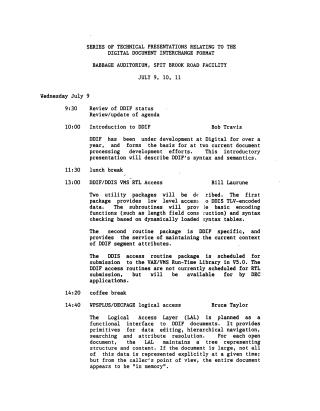
This document outlines a series of technical presentations on the Digital Document Interchange Format (DDIF), held from July 9-11, 1986. The core focus is DDIF and its underlying data syntax, the Digital Data Interchange Syntax (DDIS), within the context of compound document systems and computer graphics standards.
Key themes and topics covered include:
Introduction to DDIF and DDIS:
- DDIF is presented as a storage and interchange format for revisable compound documents, aiming to become a formal DEC standard. Its purpose is to facilitate exchange between Digital's document processors, provide efficient representation, and simplify inter-change.
- DDIS is the foundational syntax for DDIF, defining the encoding of binary and character items using TLV (Type-Length-Value) encoding based on international standards (X.409, ANS-1).
- The structure of a DDIF document, including its hierarchical segment structure, content primitives (text, graphics, images, macros), and attributes, is detailed.
DDIF/DDIS Access and Architecture:
- Presentations cover low-level DDIS/DDIF VMS RTL Access routines, which provide encoding functions and syntax checking.
- The Logical Access Layer (LAL) is introduced as a high-level functional interface to DDIF documents, supporting data editing, hierarchical navigation, searching, and attribute resolution.
- The Physical Access Layer (PAL) converts between the LAL's internal data structures (tree-based) and DDIF constructs.
- KODDIF/KODDIS are tools for encoding/decoding DDIS TLVs, checking syntax, and generating DDIS strings.
- A Cache Manager is discussed for efficiently handling document data in memory and on disk.
Character Sets:
- A dedicated session details DDIS character sets, covering 8-bit encodings (e.g., ISO Latin-1, Greek, Cyrillic, Hebrew, Arabic) and 16-bit encodings (e.g., Japanese, Chinese). The principle of "uniqueness" for characters within DDIS sets is emphasized.
Integration with Graphics Standards:
- The document reviews the status of various computer graphics standards, including GKS (Graphical Kernel System), PHIGS (Programmer's Hierarchical Interactive Graphics Standard), CGM (Computer Graphics Metafile), and CGI (Computer Graphics Interface).
- Discussions highlight the compatibility problems and proposed solutions (e.g., PHI-GKS to integrate GKS and PHIGS features like hierarchy and editing).
- PDC (Picture Description Call Interface) is presented as a device-independent graphics interface to DDIF/LAL, enabling processing, editing, displaying, and translating graphics primitives.
Compound Document Processing Strategy:
- The broader vision for compound document systems is outlined, emphasizing transparency in data interchange, unified user interfaces, seamless functionality, and extensibility.
- DDIF and DDIS are positioned as crucial components in an "open-ended compound document system architecture" that supports complex workflows across various applications (text processing, graphics, spreadsheets, forms, databases).
- The challenges of integrating existing products and defining a coherent system-wide strategy are acknowledged.
In summary, the document details the technical specifications, architectural components, and strategic importance of DDIF and DDIS as foundational technologies for creating, managing, and interchanging complex compound documents, particularly those integrating text and diverse graphical content, within Digital's ecosystem and in alignment with emerging international standards.
Site structure and layout ©2025 Majenko Technologies