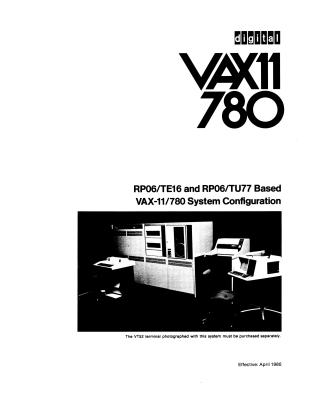
RP06/TE16 and RP06/TU77 Based VAX-11/780 System Configuration
Order Number: MISC-6840B812
This document, effective April 1980, provides configuration guidelines for the Digital VAX-11/780 system, specifically for models based on the RP06 disk and TE16 or TU77 magnetic tape drives.
Key aspects detailed include:
- Standard Configuration: The base system includes 1 MB of ECC MOS memory, an RP06 176MB disk drive, a TE16 (45 ips) or TU77 (125 ips) magnetic tape drive, an LA120 DECwriter III console terminal (which cannot be substituted), and initial I/O components like a UNIBUS Adapter (UBA) and two MASSBUS Adapters (MBAs).
Expandability:
- Memory: The system can expand from 1MB to a maximum of 12MB ECC MOS memory through combinations of local memory upgrades within the CPU cabinet (up to 4MB), a CPU Expansion Cabinet (H9602-HA/HB) for more local memory (up to 8MB total), and up to two MA780 Multiport (shared) Memory options (2MB each).
- I/O Adapters: It supports up to four UNIBUS Adapters and four MASSBUS Adapters total. Each MBA can run up to eight disk or tape drives.
- Asynchronous Lines: The system can support up to 48 asynchronous EIA or 20mA lines via DZ11 multiplexers, with further expansion possible using an add-on UNIBUS Options Cabinet (H9602-DF/DH).
- High-Performance Interface: The DR780 interface for custom devices or system-to-system connection is available, but cannot be configured if the MA780 Multiport Memory is present.
Physical Expansion: The document outlines the use and capacity of various expansion cabinets, including the CPU Expansion Cabinet and UNIBUS Options Cabinet, specifying available panel spaces and power.
- Environmental Requirements: It details recommended environmental conditions for optimal reliability, including temperature (18-24°C), relative humidity (40-60%), and rates of change for both.
In essence, the document serves as a technical guide for integrators and customers, explaining the base components, upgrade paths, and physical/environmental considerations for configuring a VAX-11/780 system in 1980.
Site structure and layout ©2025 Majenko Technologies